How to Compare Native Plant Profiles for Your Site
Use local range, climate, light, moisture, size, wildlife, and provenance fields together when choosing native plants.
On this page
A native-plant profile is a set of clues, not a single suitability score. A plant can be native to a broad region but wrong for a particular county, wetland, soil, or garden. Compare the fields that explain why a plant may fit, then look for gaps before treating it as a recommendation.
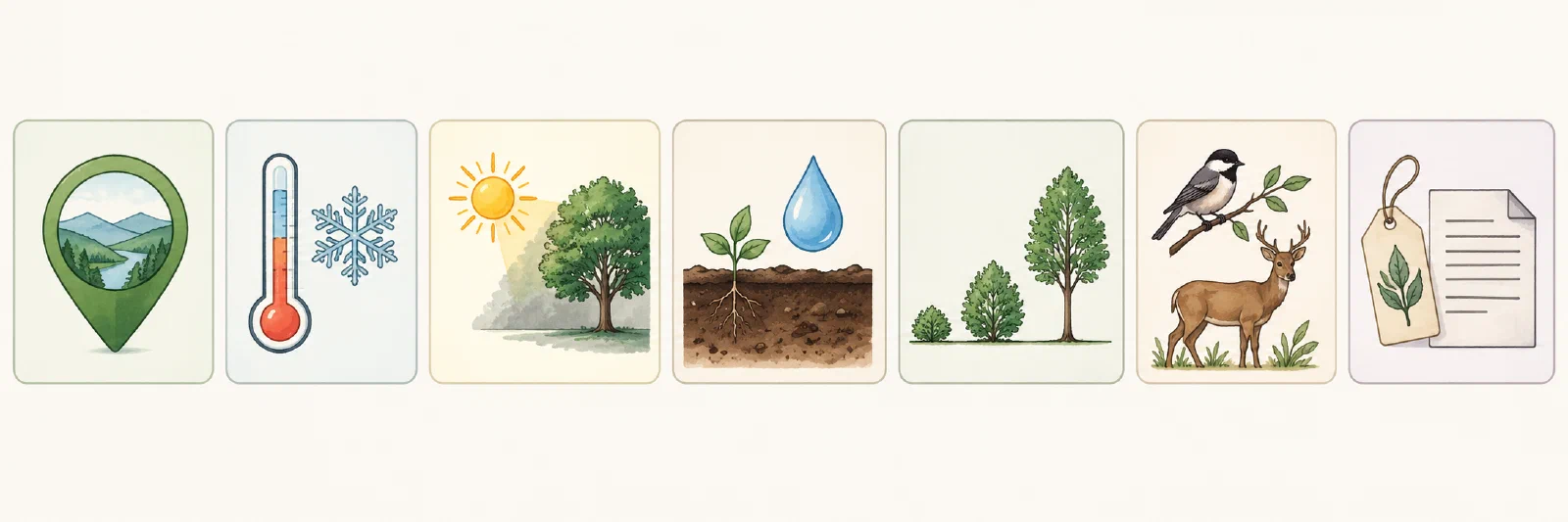
Read each field as a separate clue; a profile does not reduce site fit to one universal score.
Read the location and climate fields separately
Start with the named place or ecological region where the plant naturally occurs. “Native to North America” or “native to the eastern United States” may be too broad for a local planting decision. Check whether the record covers your state, province, territory, or ecoregion, and ask where the nursery material came from when local provenance matters.
Then read the hardiness field. Natural Resources Canada describes plant hardiness as climate context; it does not establish that a plant is native to a particular place or fits wet soil. A matching zone is useful, but it cannot replace a range check.
Compare the site conditions one at a time
| Profile field | What to ask | What it does not establish by itself |
|---|---|---|
| Light | How much direct or dappled light reaches the planting through the growing season? Is a tree canopy changing? | A shade label does not mean the soil stays moist. |
| Moisture and drainage | Is the soil dry, moist, seasonally saturated, or underwater? How long does standing water last? | “Wet” does not tell you flood duration or oxygen conditions around roots. |
| Soil | Is the soil sandy, loamy, clayey, compacted, or affected by salts or pH? | A clay label does not reveal whether the site drains slowly or has been compacted. |
| Mature form | What height, spread, habit, and seasonal structure does the plant reach? | A nursery pot size is not its mature garden footprint. |
| Wildlife and browsing | Which species or group is supported, and what does the source say about browsing? | Missing deer data is not evidence of deer resistance; a resistance label is not a guarantee. |
| Provenance and cultivar | Is the plant the straight species or a cultivar, and is its origin known? | A native species name does not prove that every cultivar or nursery source is equivalent. |
| Evidence and confidence | Is the source local and species-specific? Does it report an observation, a preference, or a tested result? | A filter in a database does not mean every plant has a verified value for that field. |
Treat shade and water as different measurements
A shaded bed can be dry. University of Maryland Extension notes that established trees can compete for moisture and that plants seen in a moist woodland valley may need more water when moved to a dry home landscape. That is a useful reminder to measure the yard itself; Maryland plant examples do not automatically apply to Virginia, Michigan, Pennsylvania, or Canada.
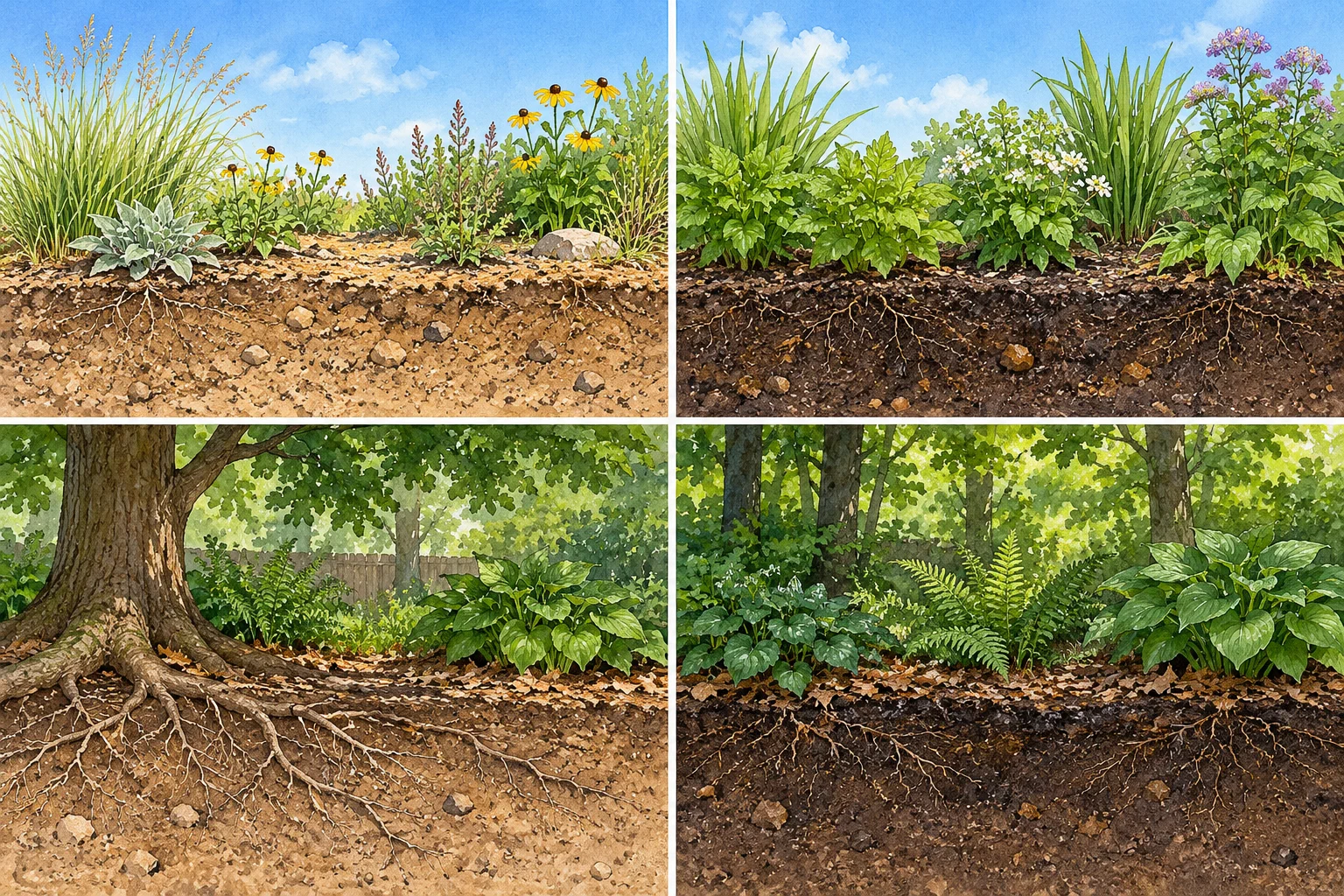
The scenes show light and moisture as separate site dimensions; they do not identify a plant for every combination.
Likewise, an entry for wet soil is not proof that a plant tolerates constant standing water. Check the source’s wording for seasonal saturation, flood duration, drainage, and soil type. If a wet-site tree may be near buried drains, review local infrastructure guidance rather than assuming the species’ water tolerance makes the location safe.
Build a shortlist from the limiting conditions
Write down your location, light, soil texture, moisture pattern, mature-space limit, and the trait that matters most. Filter for local range first. Compare the candidates that remain across the same fields, including the values that are unknown. If shade, moisture, and plant size do not overlap for any candidate, keep a no-match path: change the planting location, widen one preference, or ask a local native-plant specialist.
For focused examples, compare wet-shade plants in southern Michigan, Virginia shrubs for dry shade, Canadian evergreens for wet soil, and Pennsylvania groundcovers for clay and deer pressure.
Sources and further reading
- Plant Databaseauthoritative-secondary
- Forest classificationprimary
- Native Plants for Shadeauthoritative-secondary
- Smart Gardening: Using Native Plants Is a Smart Choice for Michigan Landscapesauthoritative-secondary
- Farm drainage systems and tree rootsprimary