Native Groundcovers for Clay Soil and Deer Pressure in Pennsylvania
Compare Pennsylvania ground-layer candidates by clay fit, moisture, light, spread, browsing evidence, and establishment needs.
On this page
No groundcover solves every combination of clay, shade, drainage, and browsing. Choose for the actual soil and water pattern first, then treat deer response as a qualified trait. Pennsylvania Extension’s examples include useful candidates, but the sources do not establish that any one plant will cover every county or survive compacted, waterlogged clay without protection.
Compare candidates by the constraint they address
| Candidate | Supported fit | Important limit |
|---|---|---|
| Common blue violet (Viola sororia) | Penn State describes violets as a low-maintenance groundcover for difficult Pennsylvania landscapes and uses deer-resistant language. The common blue violet can tolerate clay; most violets prefer moist conditions and partial shade. | “Deer resistant” is not deer proof. Rhizomes can form colonies that may choke nearby plants, so leave room for spread and monitor the edge. The source does not establish performance in compacted or persistently flooded clay, or the local range of every violet species and cultivar. |
| Golden Alexander (Zizia aurea) | Penn State lists sun to partial shade, moist sandy or sandy-clay soil, and wet-to-moist rain-garden zones. It reaches about 12–24 inches, self-seeds, can form groundcover, and is described as deer resistant. | The profile does not prove performance in compacted clay or continuous standing water. Watch its spread and confirm local range and nursery stock. |
| Golden groundsel (Packera aurea) | Penn State describes quick reseeding or spread, spring flowers, and deer- and rabbit-resistant behavior. | Its cited profile does not establish dense-clay fit. Treat it as a browsing and spread comparison, not a clay-soil answer. |
| Virginia spring beauty (Claytonia virginica) | A Pennsylvania Extension garden article describes a 4–6 inch spring layer that tolerates shade and sun and moist to drier soils. | It is seasonal rather than year-round cover; clay and deer performance are not established. See Native spring groundcovers for Pennsylvania gardens. |
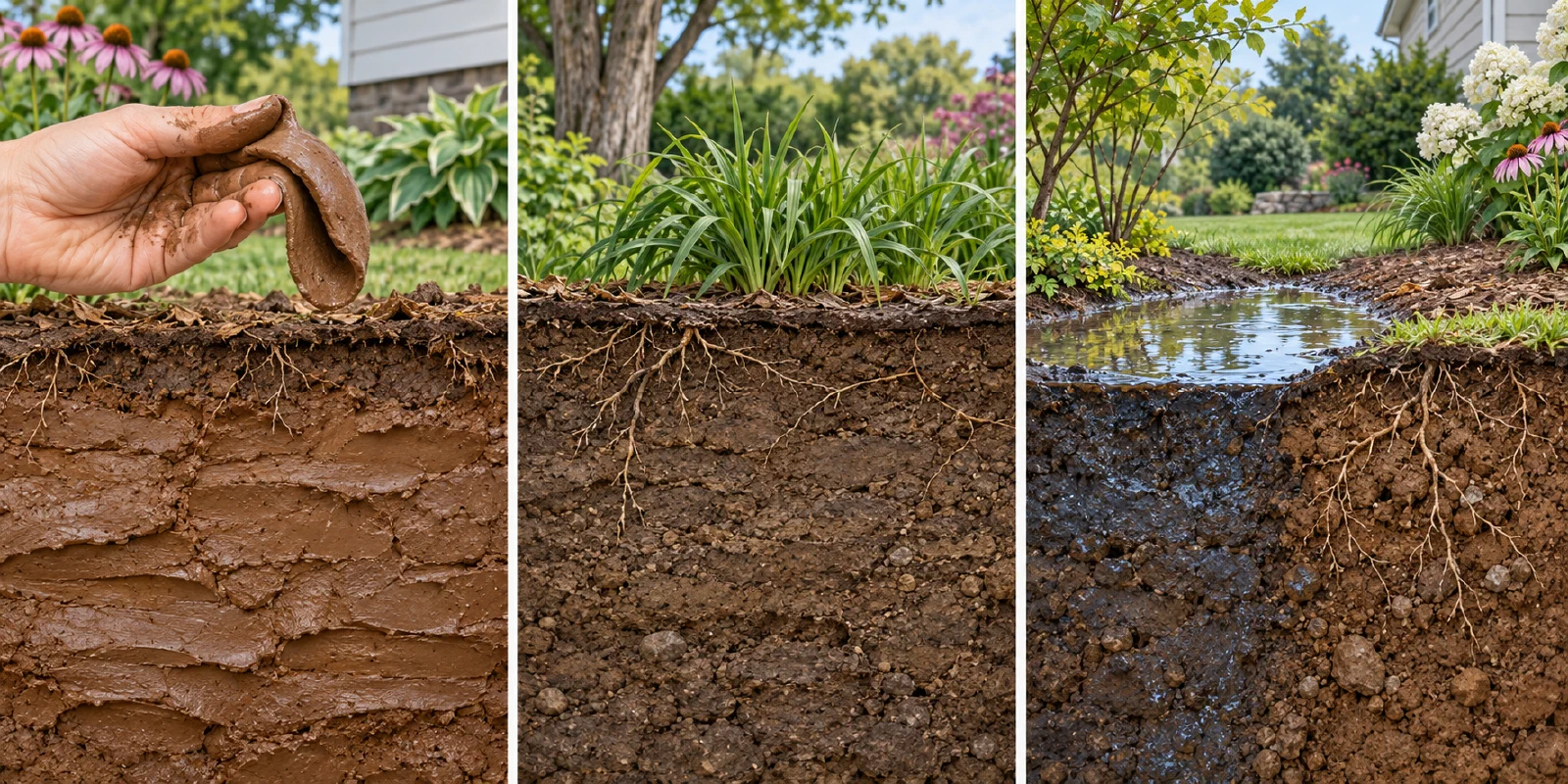
The cutaways illustrate distinct soil and moisture questions; they are not a treatment recipe.
Check clay, drainage, and compaction separately
Clay is a soil texture; it does not tell you whether a planting area is compacted, holds water, or dries out between rains. Notice how quickly water leaves the surface and whether the ground becomes hard or cracked later in the season. A soil test can clarify pH and nutrient conditions. Penn State cautions that large amounts of organic matter in an individual planting hole can hold excess water around roots, so do not apply a blanket amendment recipe without checking the site and current soil guidance.
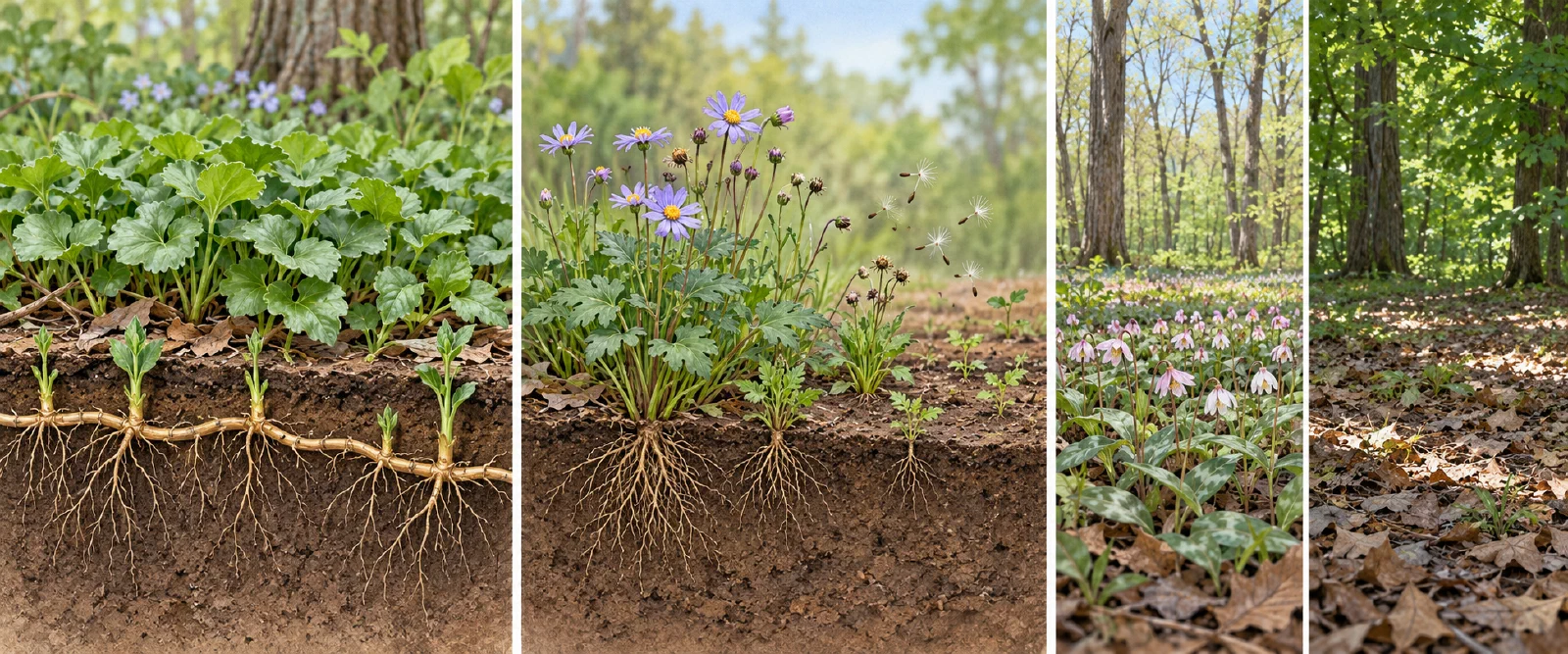
These generic forms illustrate different spread and season patterns; identify candidate species from the cited profiles.
Make browsing and establishment part of the comparison
Deer pressure changes with place, season, and available food. Source labels such as “less preferred” or “deer resistant” describe relative behavior, not immunity. Monitor new plants and use appropriate protection where browsing is high. Leave room for species that reseed or spread quickly, and avoid relying on a single plant to create a uniform carpet on a difficult site.
Penn State recommends soil testing, removing existing grass and weeds, and planting most groundcovers in spring or fall so they can establish before summer stress. Match those steps to the plant, the site, and local advice. If no candidate fits both the soil and browsing conditions, keep the no-match result and compare a different planting location or a mixed ground layer rather than claiming a guarantee.
Sources and further reading
- Native Violetsauthoritative-secondary
- Rain Garden Plants: Golden Alexander (Zizia aurea)authoritative-secondary
- Native Groundcovers Can Solve Tough Challenges in the Landscapeauthoritative-secondary
- Planting Ornamentalsauthoritative-secondary
- Spring Ephemerals for Residential Gardensauthoritative-secondary