How to Screen Native Evergreens for Wet Sites in Canada
Use a province-first screen to compare native evergreens for wet sites, with Ontario examples and separate checks for water pattern, shade, salt, and mature form.
On this page
“Canada” is too large a planting zone for one native evergreen shortlist. Province, ecozone, local range, light, and water duration all matter. A hardiness zone helps describe climate; it does not establish that a species is native nearby or can tolerate saturated soil.
Start by describing the site. Is the ground moist, seasonally flooded, or wet for long periods? Does water stand after rain? Is the soil mineral or peat-based? Does the site receive full sun or canopy shade? Southern Ontario’s ecological classification distinguishes wetland settings such as swamps, fens, bogs, and marshes; those labels describe different vegetation and site contexts, not interchangeable garden conditions.
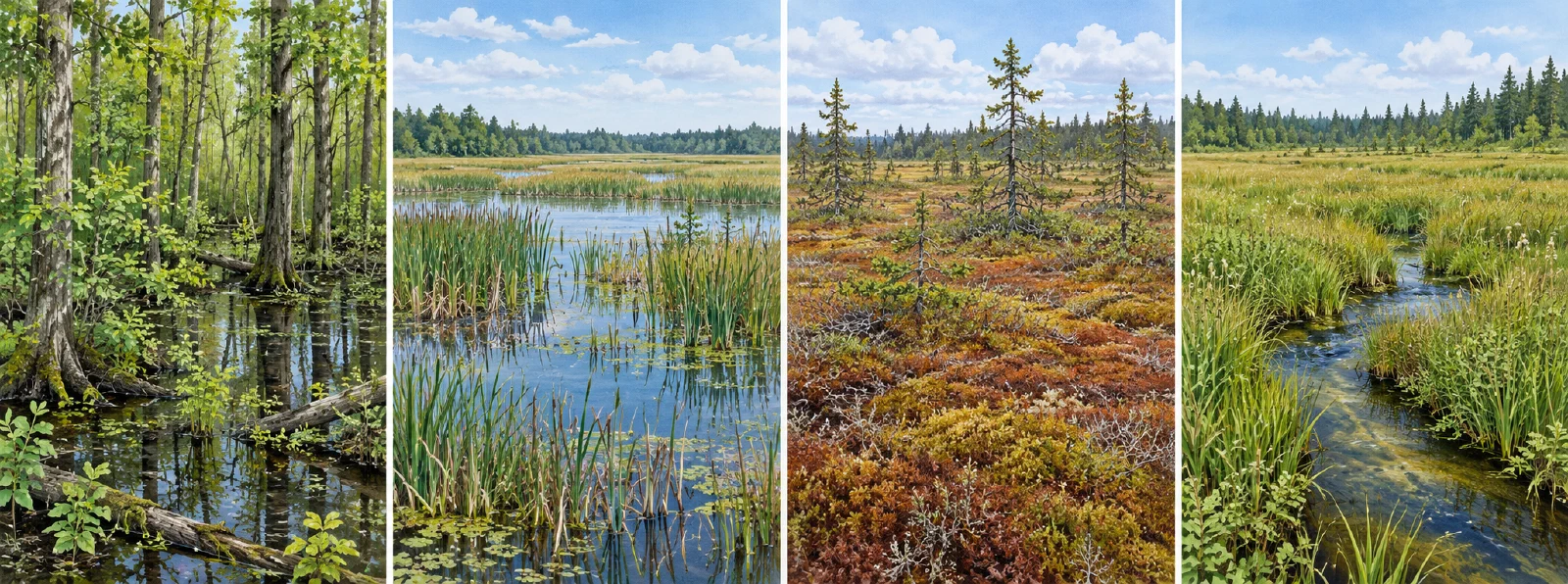
These broad landscape examples distinguish ecological settings; they are not interchangeable garden prescriptions.
Compare the Ontario examples carefully
| Plant | What the Ontario evidence says | Screening limit |
|---|---|---|
| Eastern white cedar (Thuja occidentalis) | It occurs throughout Ontario and is often associated with swampy limestone sites. The provincial profile says it grows best in moist soil and tolerates some shade. It can reach about 15 metres; deer browse its twigs in winter. | The evidence does not establish tolerance of continuous ponding. It is a tree that may be used as a hedge, not a compact shrub by default. Avoid road-salt exposure and verify the local source and mature space. |
| Black spruce (Picea mariana) | An Ontario profile describes it as a transcontinental Canadian species that tolerates varied moisture and partial shade; wetland-grown trees are smaller. | This is an evergreen tree, not a small shrub. The profile does not specify how long residential standing water can persist or give a compact landscape size. |
| Eastern hemlock (Tsuga canadensis) | Southern Ontario forest guidance describes it as highly shade tolerant, usually associated with moist-to-fresh soils, with some wet sandy swamp-border occurrences. | Shade tolerance does not establish tolerance of saturated soil. Salt, canopy competition, local range, and mature size need separate checks. |
| Tamarack (Larix laricina) | Southern Ontario guidance includes heavy clay in its moisture range but warns against prolonged water collection; it is very shade intolerant. | Tamarack is a deciduous conifer. It loses its needles and does not provide evergreen winter foliage. |
The Ontario eastern white cedar profile is a useful species-level example of why moisture, shade, road salt, browsing, and size belong in separate fields. It is not a Canada-wide prescription. Ontario sources also list wet-fringe shrubs such as speckled alder, buttonbush, red-osier dogwood, winterberry, and sweet gale, but those examples are not all evergreen and still require local range and light checks.
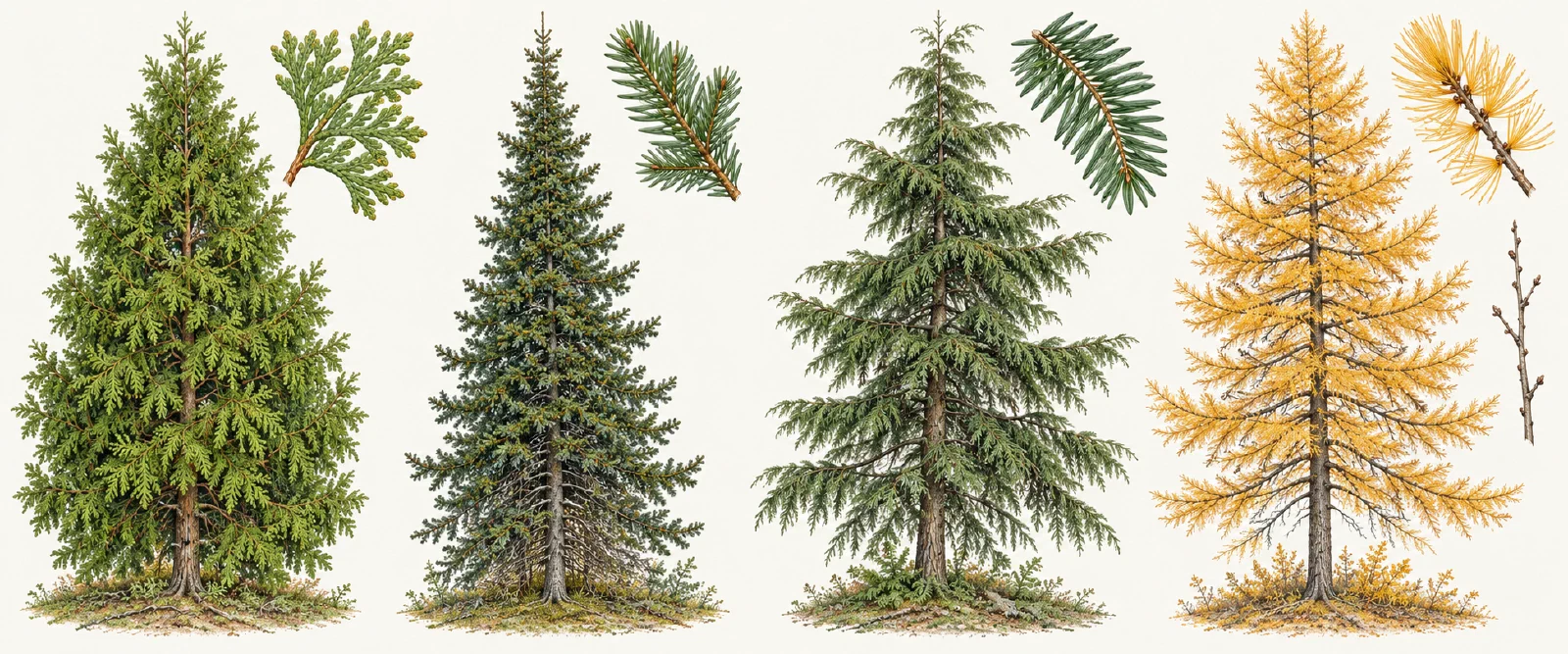
The illustrations support visual orientation; use a reliable botanical reference for identification and confirm the local plant’s mature form.
Use a local screening sequence
- Select the province or territory and the nearest ecological region. Check a local native-range source rather than relying on a country-level label.
- Describe the wetness pattern and soil. “Wet” does not tell you whether water stands, how long saturation lasts, or whether soil is acidic peat, clay, or mineral soil.
- Compare actual light, mature form, salt exposure, and browsing pressure with a species-level profile. A tree’s wetland occurrence does not guarantee residential performance.
- Confirm the exact species or cultivar and the nursery source. Ask whether the plant’s origin is known and appropriate to your area.
- If wet-soil fit is firm but the evergreen requirement leaves no suitable local candidate, consider a locally native deciduous shrub or mixed structure instead of forcing an unsuitable evergreen into the site.
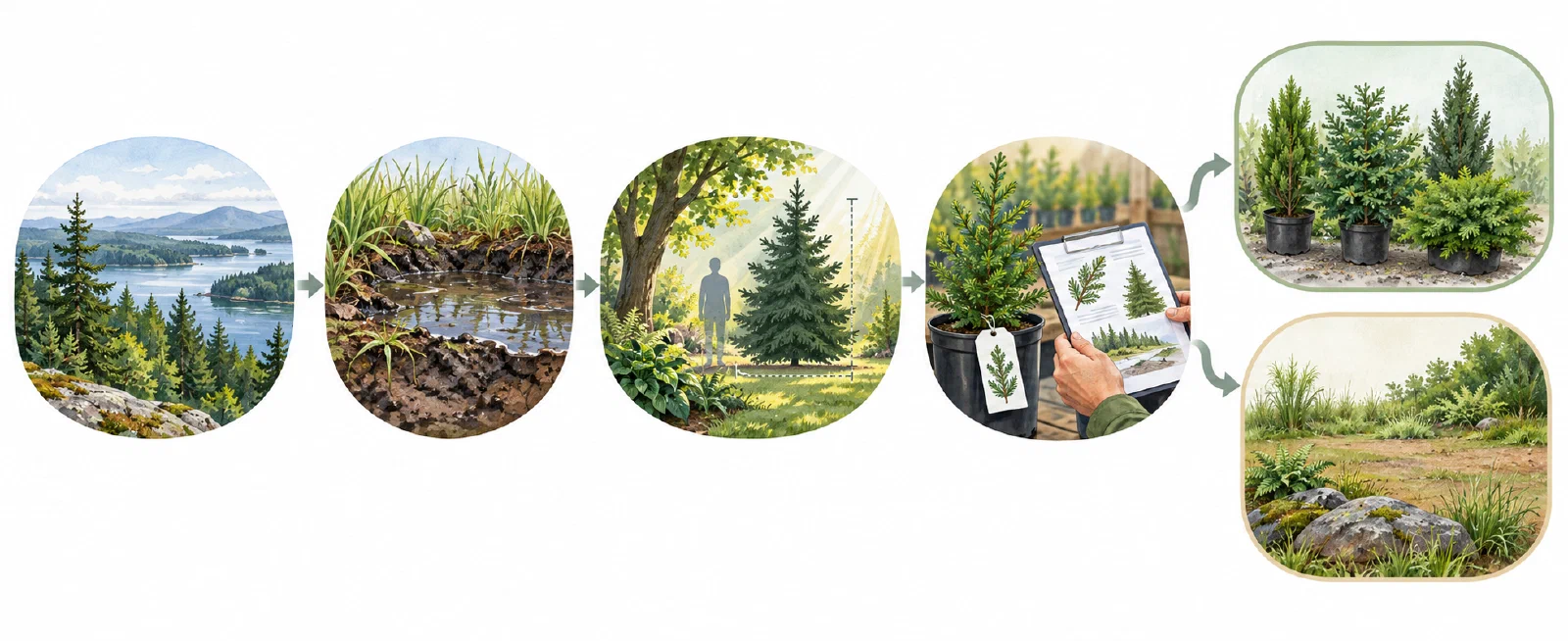
The sequence ends in a no-match option when the local evidence does not support a suitable evergreen.
Where buried field drains or other infrastructure may be present, check their location and current local guidance before planting wet-tolerant trees. Ontario drainage guidance documents a root-conflict concern in its agricultural context; it is not a universal setback rule for every yard. For more on reading profile fields, see How to compare native plant profiles for your site.
Sources and further reading
- Forest classificationprimary
- Eastern white cedarprimary
- Black spruceprimary
- Common trees — Forest Resources of Ontario 2021primary
- Afforestation Guide for Southern Ontarioprimary
- Silvicultural Guide for Managing Southern Ontario Forestsprimary
- References and Appendices — Stormwater Management Planning and Design Manualprimary
- Farm drainage systems and tree rootsprimary
- Ecological Land Classification for Southern Ontarioprimary