Native Plants for Clay Soil in Michigan
Separate clay texture from compaction, ponding, pH, and seasonal water before screening plants for a Michigan site.
On this page
Clay is a soil texture, not a complete site diagnosis. It can hold water and nutrients, yet drain slowly after rain; as it dries, some of that stored water may be difficult for plants to access. Compaction, a low spot, a dense layer below the bed, shade, or runoff can create different problems even where the soil also contains clay. Separate those conditions before choosing plants or changing the soil.
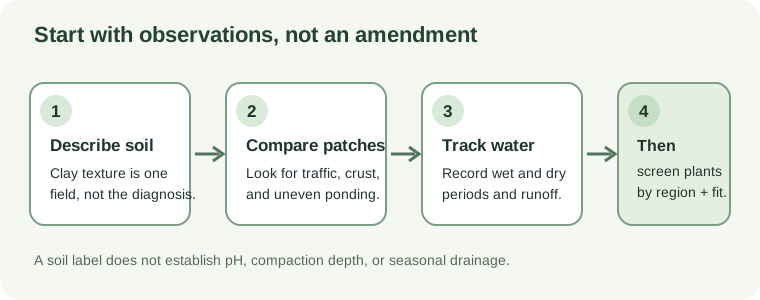
Record the site before treating it
Watch the bed after ordinary rain and again during a dry period. Note where water stands, whether it moves across the surface, how quickly the surface dries, and whether the pattern changes across the yard. Compare the area with a nearby spot that has similar light but less foot traffic. A compacted patch may be caused by repeated traffic, construction, or wet-soil work; ponding alone does not identify the cause.
Record the hours of sun, nearby tree roots, slope, roof or driveway runoff, and the depth and width available for planting. A clay label does not establish pH, the length of seasonal saturation, or whether a plant can root through a compacted layer. Use the site assessment worksheet to keep these observations together.
Use maps, tests, and plant lists for different questions
A soil test can help describe texture and pH and guide nutrient decisions. Ask the laboratory how its results should be interpreted for the plants and use you have in mind. A routine fertility test does not diagnose compaction, explain every drainage problem, or prove that a bed is safe from contaminants.
The USDA Web Soil Survey can show mapped soil information for a defined area in the United States. It is a landscape-scale starting point, not a measurement from the planting hole. Check the soil reports and field-check guide for what each method can and cannot tell you. Avoid applying sand or another amendment from a soil label alone; use current local test results and extension guidance for any change.
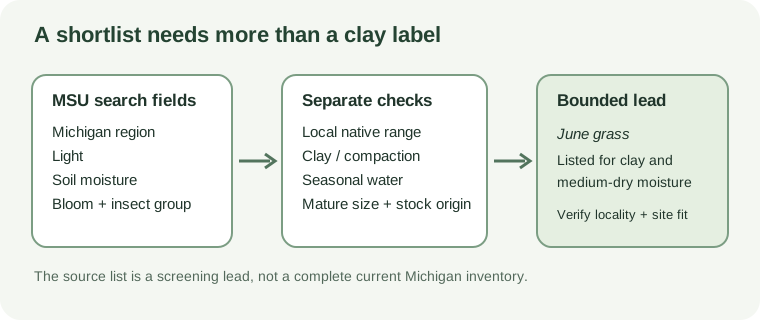
Michigan State University’s plant search tool lets you choose a Michigan region and filter plants by moisture, light, bloom period, and insect group. Those filters help narrow a list but do not measure clay tolerance or guarantee fit for one property. Confirm the plant’s local range, mature dimensions, and actual light and water needs separately. Ask a nursery where its stock originated; a plant’s state-level native status does not identify the geographic origin of that particular lot.
One bounded clay-soil lead
The Van Buren Conservation District’s 2014 homeowner guide, hosted by Michigan EGLE, lists June grass (Koeleria macrantha) as clay-tolerant and associates it with medium-dry moisture. Treat it as a candidate to investigate, not a complete Michigan recommendation: the guide is dated, its plant table is not a full current native inventory, and the entry does not establish county-level occurrence or performance in a compacted bed. Check the species against your Michigan region, site light, seasonal water, mature size, and the source of nursery stock before adding it to a shortlist.
When plant selection is not the next step
If the area repeatedly floods, receives concentrated runoff, lies beside a foundation, or has a suspected contaminant or buried utility, investigate that constraint before planting or excavating. A plant choice cannot establish that drainage changes are safe. Use the site-escalation guide when soil, water, or project questions exceed ordinary plant matching.
Once the site record is clear, compare plants on several fields at once: local native range, light, moisture pattern, soil, mature size, and intended use. Clay may be one part of the match, but it should not stand in for the rest of the site.
Sources and further reading
- Landscaping for Water Quality: Garden Designs for Homeownersprimary
- Plant Search Tool — Native Plants and Ecosystem Servicesauthoritative-secondary
- Smart Gardening: Using Native Plants Is a Smart Choice for Michigan Landscapesauthoritative-secondary
- Soil testing for lawns and gardensauthoritative-secondary
- Getting Started With Web Soil Surveyprimary