Which Regional Plant Source Should I Use?
Choose a regional plant source by the question you need answered: native range, occurrence, ecological setting, hardiness, conservation, or garden candidates.
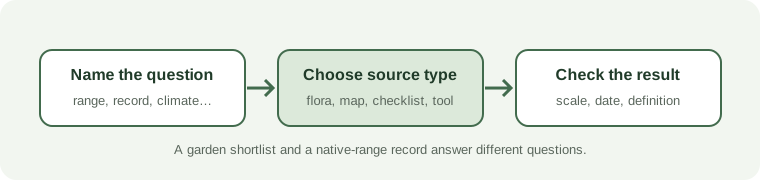
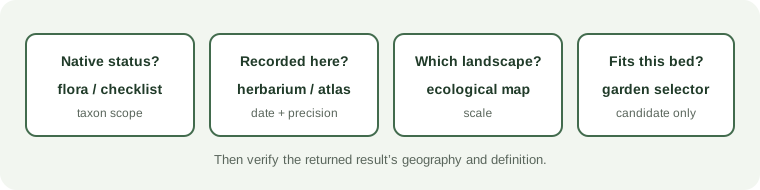
Choose the source after naming the question. A tool that helps select plants for a garden may not be an occurrence atlas, and a map that shows occurrences may not say whether those plants are native.
| If you need to know… | Start with… | Keep in mind… |
|---|---|---|
| Whether a taxon is treated as native in a jurisdiction | A current flora or vascular-plant checklist | Status terms and taxonomy are source-specific; province-wide status is not county proof. |
| Whether it has a documented local record | A herbarium, flora map, or occurrence database | Check date, locality precision, and whether the record is native, planted, or historical. |
| What ecological setting describes a place | EPA or jurisdictional ecoregion and land-classification maps | Ecological units do not follow every municipal boundary or provide a plant inventory. |
| Whether winter climate is within a plant’s tolerance | The current hardiness resource for that country: Government of Canada or USDA | Hardiness is climate context, not native range or site fit. |
| Which garden candidates suit site filters | A regional garden selector or planting guide | A filtered candidate is not automatically a verified local-native occurrence. |
| Where sensitive or rare features are tracked | A natural-heritage or conservation source | It may focus on tracked features and generalize locations. |
Examples show why the distinction matters. The Pennsylvania Flora search supports taxon and county lookup. VASCAN provides Canadian taxonomic and province-status context. Alberta’s ACIMS provides conservation lists and occurrence data, with limits on sensitivity and coverage. These sources serve different scales and purposes.
City garden tools can answer a different question. Toronto’s native-plant selector lets gardeners filter candidates by site traits; its catalog fields do not establish a taxon’s occurrence in every Toronto neighborhood. Calgary’s YardSmart page presents non-exhaustive wildflower examples and asks gardeners to consider light, moisture, soil, and space. Use either as a starting shortlist, then verify local range and site needs in appropriate sources.
Before searching, write down the plant or place, the geographic scale you need, and whether your question is about nativity, occurrence, ecology, climate, conservation, or garden performance. After a result appears, interpret its legend and limits in the map-reading guide. For a named plant, use the accepted scientific name and check the source’s date and definitions before treating its output as a local answer.
Sources and further reading
- About Native Plants Finderauthoritative-secondary
- Plant Searchspecialist
- VASCAN Checklistprimary
- Access ACIMS Dataprimary
- Ecoregions of North Americaprimary
- Plant Hardiness Zones of Canada datasetprimary
- USDA Plant Hardiness Zone Mapprimary
- Toronto Native Plants, Trees and Shrubsprimary
- Toronto Native Plant Selector Catalogprimary
- YardSmart Native Wildflowersprimary