Native Plants for Southeast Michigan: Ecoregion, County Range, and Hardiness
Use a Southeast Michigan location to find plant records, then keep ecoregion, county range, hardiness, and garden fit in their proper roles.
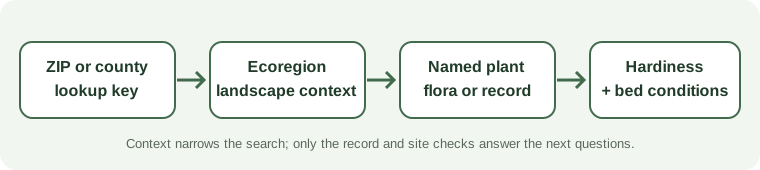
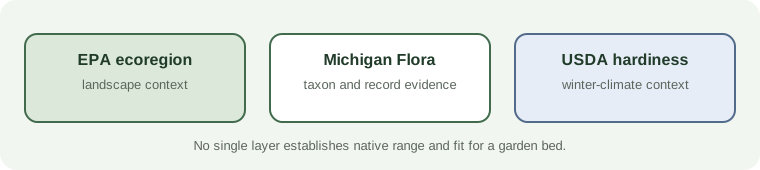
A ZIP code or county is a useful starting point, but first check which geography the result actually represents. A ZIP-based tool may return a county. An EPA ecoregion adds broad landscape context; it does not list every plant native to that county or show what grows in one yard.
For a plant-specific question, search the accepted scientific name in Michigan Flora Online. Read the map key and the underlying locality and collection information when available. A mapped specimen can document a collection without showing that the species occupies the whole county today. Some locations are approximations, and sensitive rare-plant locations are deliberately generalized.
Michigan Natural Features Inventory County Element Data is a planning reference whose county lists can include current or historical records. Treat a listing as a lead to investigate, not a residential inventory. Uneven botanical collecting also means a short county list, or a missing entry, cannot by itself establish ecological absence.
The National Wildlife Federation Native Plant Finder uses historic county-range information for its ZIP lookup. Its adjacent-county suggestions can help gardeners identify candidates, but they do not change the source county result or prove local nativity. Check a candidate in a Michigan flora or another appropriate state source.
Keep winter climate separate from range. The USDA hardiness map estimates winter-temperature context; it does not show whether a plant is native, whether its nursery stock came from nearby, or whether it fits your soil, moisture, light, and space. Before planting, verify the name and local evidence, then match the candidate to the actual bed and ask about plant-material origin when that matters.
Sources and further reading
- Ecoregions of North Americaprimary
- Michigan Flora Onlineprimary
- County Element Dataspecialist
- About Native Plants Finderauthoritative-secondary
- Map Creation, 2023 Plant Hardiness Zone Mapprimary