Hardiness Zone Versus Native Status in Alberta
Separate Canadian winter-climate information from Alberta status, natural-region context, occurrence evidence, and garden conditions.
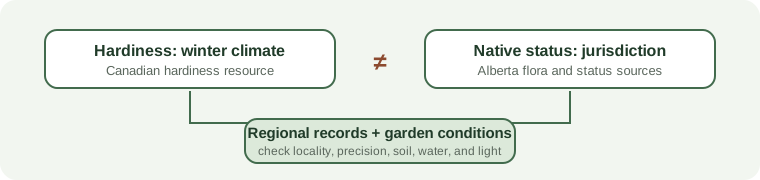
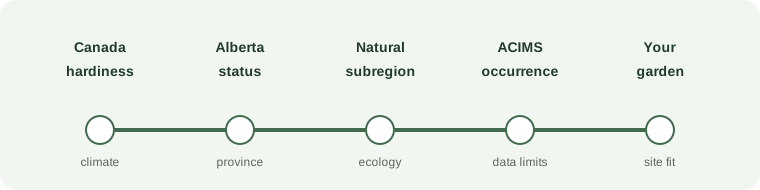
A plant may survive Alberta winters without being native to Alberta, and a species native somewhere in the province may not suit your garden. Start by treating hardiness and nativity as separate questions.
Canada’s current plant-hardiness resource is a climate layer for perennial survival, not a native-range map. Check its edition and the map result for your location. Alberta status sources answer a different question: the province’s vascular-plant indicators can help verify a taxon and its provincial treatment, but province-wide status does not say where in Alberta it occurs.
Alberta’s range classification materials describe six natural regions and 21 subregions that add ecological context. Use a current map or regional description to identify the unit for your place; the unit is not itself a plant list. Range and ecological-site tools were developed for resource and range-management decisions, so translate their scope carefully before applying them to a residential bed.
The Alberta Conservation Information Management System provides element lists and occurrence information. Sensitive locations may be generalized, records are incomplete, and no displayed occurrence does not establish absence. Check the source’s data date, taxon, and spatial precision before relying on a result.
Local city resources can help with the next step while keeping their own limits visible. Edmonton’s native-plant guidance distinguishes locally native plants from broader Prairie-ecozone or Canada-wide examples; that city guidance is not a taxon-level inventory. Calgary’s YardSmart wildflower page offers a non-exhaustive, homeowner-oriented set of examples organized by exposure and asks gardeners to consider moisture, soil, and space. Neither is proof that every listed plant occurs naturally at every address.
Finally, forest seed zones address genetic-resource management in forestry, not a universal home-garden transfer rule. For plant origin and seed-transfer questions, see Native Status and Provenance or the regional source guide. If seed or plants will cross a jurisdiction, check current official requirements and ask suppliers what they can document about origin. Then match the candidate to the actual light, water, soil, mature size, and intended role of the site.