Plant Communities & Habitat Design
How to adapt a native plant community to your yard
Use local ecological references and measured site conditions to turn a natural-community idea into a practical residential planting plan.
On this page
A natural plant community is a useful reference for understanding which plants occur together under particular conditions. A home landscape is smaller, altered, and managed, so copying a natural community species-for-species can miss the site’s soil, water, light, space, and maintenance needs. Use the reference to ask better questions, then design for the yard you have.
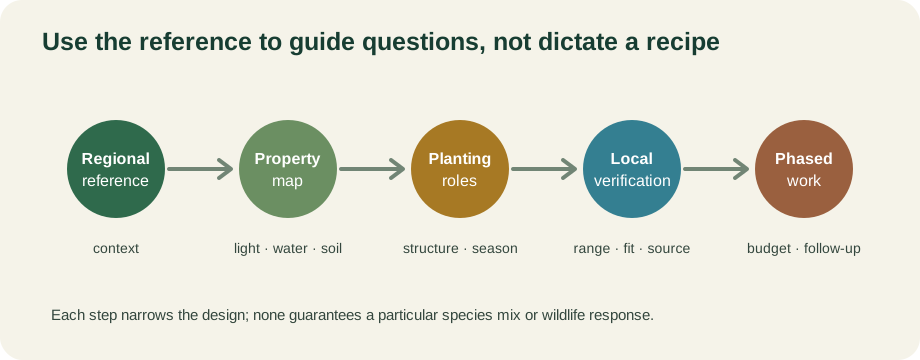
Start with place, then map the property
Choose a reference from the same broad ecological region and landscape setting as the yard. Classification systems connect landform, soil, water, and vegetation, but they work at different geographic scales and do not all transfer across state or provincial borders. Restoration research also shows that disturbance and site history can leave several plausible reference states rather than one fixed target.
At home, map where sun falls through the season, where water enters and drains, what soil tests show, and how mature trees, slopes, paths, and buildings constrain planting. Divide areas that behave differently even if they sit close together. Those observations are more useful than treating a hardiness zone or a broad regional label as proof of plant fit.
Assign roles before choosing names
Plan the structure first: canopy or small trees where space allows, shrubs, seasonal flowers, grasses or sedges, and lower layers. Check mature height and spread, local native range, soil and moisture fit, source identity, and likely maintenance for every candidate. Leave a role open if no local plant source confirms a fit. Habitat functions are possibilities, not guaranteed wildlife results.
Choose a workable planting format
Seed, plugs, and larger plants have different costs and timelines. Penn State’s Pennsylvania rain-garden guidance says larger plants can fill a small area faster but cost more and need larger holes; plugs are smaller and may take longer to fill. A Michigan campus project combined plugs and seed across several sites, but it was not a residential comparison. Treat both as examples, not a universal ranking. Ask local suppliers for quotes, origin, mix contents, and planting directions, then choose a phase that fits your budget and follow-up capacity.
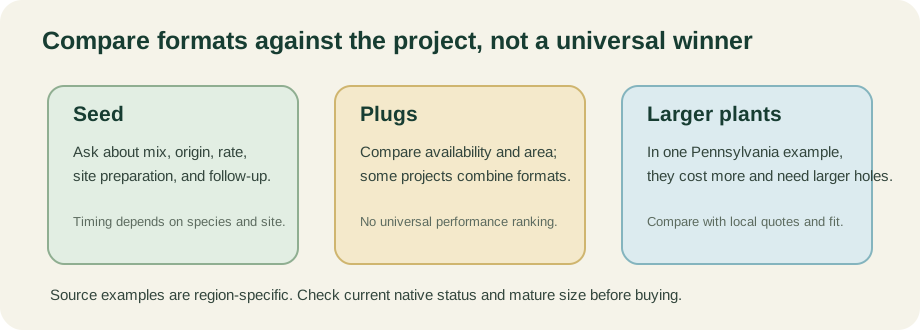
The result should echo the reference’s useful structure while remaining honest about what is known for the property. See the Ontario wet-shade guide, Virginia dry-shade guide, and Michigan meadow guide for examples of regional limits.
Sources and further reading
- Using Landscape Hierarchies To Guide Restoration Of Disturbed Ecosystemsprimary
- Ecological Land Classification for Southern Ontario: Training Manualprimary
- Ecological land classificationprimary
- Native Plants in the Landscape: Incorporating Native Plantsauthoritative-secondary
- Landscape Designs with Native Plantsspecialist
- Rain Gardensauthoritative-secondary
- MSU transforms unused lawns into thriving pollinator habitatsauthoritative-secondary