Plant Communities & Habitat Design
Native dry-shade community design for Virginia
Plan a Virginia dry-shade planting around canopy, roots, slope, and seasonal moisture, then verify each candidate for the local region.
On this page
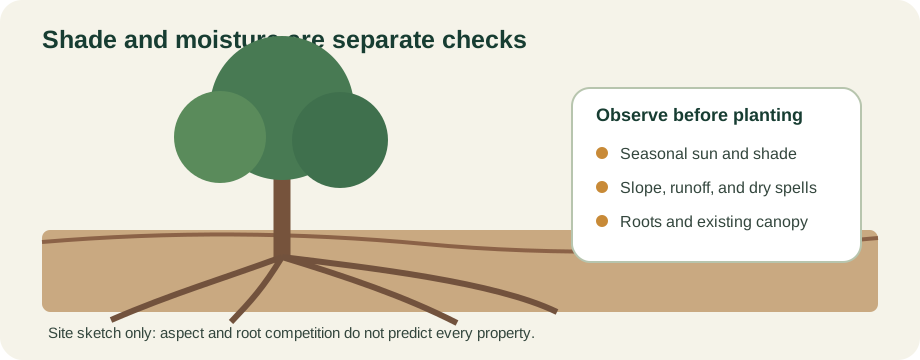
Shade does not tell you whether a bed is dry. Beneath a mature tree, dense roots may take up water even where rain reaches the ground; a slope or south-facing aspect may also dry faster. Virginia woodland communities vary with landform, light, moisture, and succession, so begin with the actual site rather than a generic shade list.
Diagnose the shade before choosing plants
Map the area through the growing season. Note the hours and direction of sun, where runoff flows, whether leaf litter stays damp, and how the soil feels during a dry spell. A south-facing slope is often drier and a north-facing one often moister, but those are regional tendencies, not a substitute for measuring your yard. Keep mature trees and their roots in view; do not dig or cut structural roots to make a planting fit.
Build a layered design from the ground up
Keep existing canopy as the upper layer, then decide whether the site has enough light and moisture for an understory shrub, a seasonal flowering layer, or a low ground layer. A smaller, less densely planted bed can be more realistic than forcing every layer into a root-filled patch. Plan for establishment watering and follow-up; dry shade may not support a low-input planting without help.
Virginia’s wildlife gardening guide lists selected shrubs with separate fields for shade, drought and wet-soil tolerance, mature height, fruit, pollinator value, and deer notation. Use those fields to compare candidates, then verify county or ecoregion range and exact site fit in a current Virginia source. The list is not a complete community or proof that every listed plant belongs in every Virginia yard.
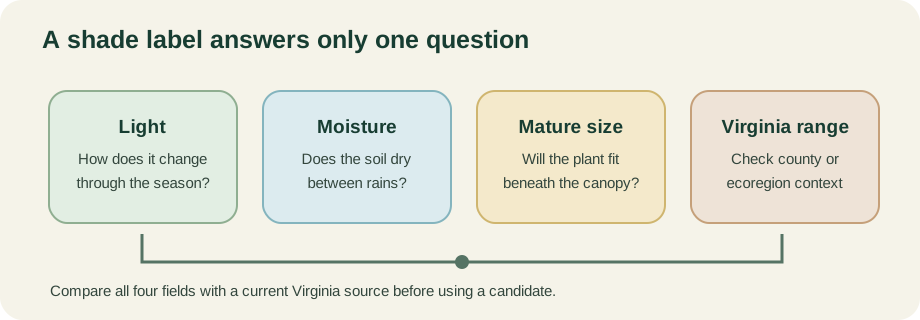
If no candidate fits the measured light and moisture together, adjust the goal: protect the tree, reduce the planted area, or use a managed understory. See how to adapt a native plant community for a site-first selection method.
Sources and further reading
- Habitat Gardening for Wildlifeauthoritative-secondary
- Native Plants in the Landscape: Incorporating Native Plantsauthoritative-secondary
- Welcome to the Woods! A Guide for New Virginia Woodland Ownersauthoritative-secondary