Plant Communities & Habitat Design
Native wet-shade woodland-edge palette for Ontario
Use Ontario ecological context and water patterns to plan a wet-shade woodland edge without treating a regional list as a universal recipe.
On this page
Wet shade is a combination of two changing conditions: how much light reaches a bed and how long its soil stays wet. A shaded edge may be damp, briefly flooded after snowmelt, or waterlogged for part of the year. Start with those differences before choosing plants; a province-wide list cannot describe every yard.
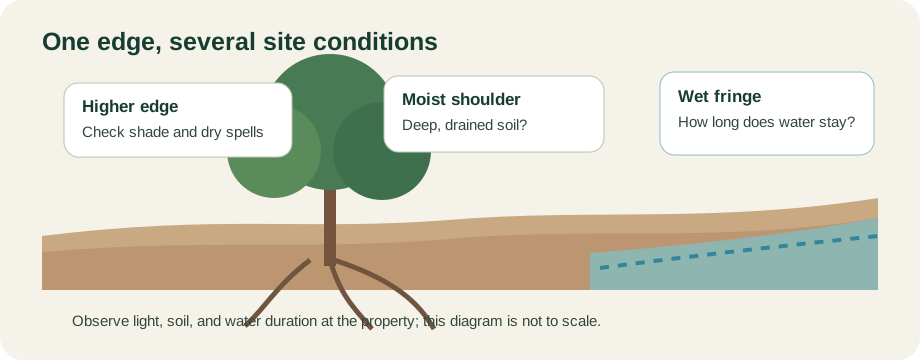
Map the woodland edge
Watch the area in more than one season. Note when the canopy casts shade, where roof or slope runoff enters, where water remains after rain, and whether the soil dries between wet periods. Check the soil and the shape of the land as well as the plant cover. Southern Ontario’s ecological land classification connects landscape context to landform, soil, moisture, and vegetation; it helps frame a reference community, but it does not identify the community of a particular property.
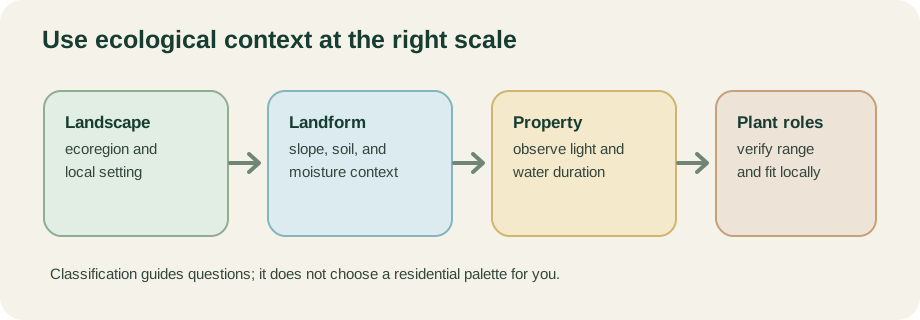
An Ontario stormwater planting list separates shoreline fringe, flood fringe, and upland conditions. Use that as a reminder that water changes over short distances, not as a complete woodland-edge palette. A natural community is a comparison point, not a residential recipe.
Give each microzone a role
Place plants only after the wet-to-dry pattern is clear. The lowest edge may need plants that tolerate temporary flooding; a damp, well-drained shoulder can support a different shrub or small-tree layer; a higher, drier edge needs another fit. In every zone, check local range, mature spread and height, light, soil, and the amount of maintenance the space can receive.
Alternate-leaf dogwood (Cornus alternifolia) is one bounded Ontario example. The provincial profile describes it for partial shade to sun and evenly moist, deep, well-drained soil, with a mature height of about 8–10 metres. That makes it a poor choice for a permanently saturated or compacted patch and too large for many small beds. Verify its local range and room before treating it as an option.
The evidence does not establish a complete Ontario woodland-edge species list, planting quantities, or a universal ground layer. Keep unfilled roles open until a current local plant source confirms range and fit. For a general method of translating a reference community to a measured yard, see how to adapt a native plant community.