Plant Communities & Habitat Design
Clay-soil pollinator meadow community in Michigan
Plan a Michigan clay meadow by separating soil texture from drainage and compaction, then choosing regionally native functional groups.
On this page
Clay is a soil texture, not a complete drainage diagnosis. A clay bed may hold water, drain between storms, or be compacted by traffic; those conditions call for different plant choices. In Michigan, start with your region and measured site before building a pollinator meadow from a seed mix.
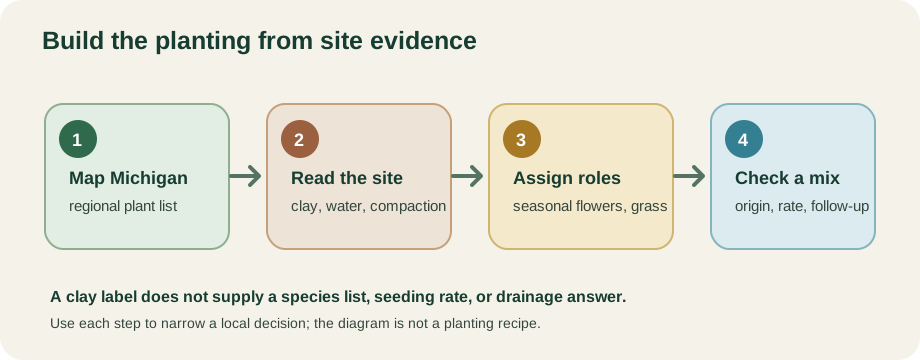
Separate soil texture from site behavior
Map how sun, slope, and runoff affect the bed. Use a soil test and observe how long water remains after rain; a clay label alone does not identify saturation, compaction, or suitable species. Michigan State University Extension organizes native plant lists by the Upper Peninsula, northern Lower Peninsula, and southern Lower Peninsula and recommends soil testing. Check the list for your region, then compare each candidate’s light, moisture, mature size, and local source.
Plan roles across the season
Build the planting around locally verified roles rather than a ready-made universal palette. Michigan NRCS guidance suggests at least three flowering species in each of its early, middle, and late periods, plus a site-adapted native bunchgrass or sedge. Treat that as one design framework: confirm plant identity, bloom timing, and fit for your site. Flowers alone do not guarantee a pollinator response.
Seed, plugs, and larger plants serve different budgets and schedules. An MSU campus project combined native plugs and seed across six clay-heavy sites, but it was not a controlled comparison or a residential quantity guide. A separate Michigan field experiment found more established forb cover at its higher seed rate on sandy loam; that rate does not set a recommendation for a clay yard. Ask a regional supplier for a rate matched to the exact mix and area, and compare preparation and follow-up needs.
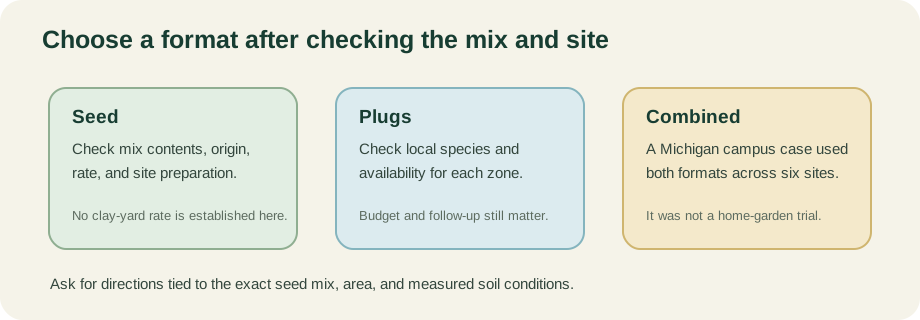
Research on Michigan prairie restorations also does not establish a universal seed-transfer distance or long-term provenance rule. Keep source identity visible and ask suppliers where material came from. For the broader process of translating a community reference into a home design, see how to adapt a native plant community.
Sources and further reading
- Ecoregional Planting Guidesspecialist
- Pollinator Biology and Habitatprimary
- Smart Gardening: Using Native Plants Is a Smart Choice for Michigan Landscapesauthoritative-secondary
- MSU transforms unused lawns into thriving pollinator habitatsauthoritative-secondary
- Pollinator planting establishment and bee visitation are influenced by seeding rate and post-seeding managementprimary
- Where should they come from? Where should they go? Several measures of seed source locality fail to predict plant establishment in early prairie restorationsprimary