Pollinator plants for zone 6 full shade in Pennsylvania
Choose Pennsylvania shade plants by moisture, season, and wildlife function. Zone 6 helps screen for winter cold, but it does not establish local nativity or full-shade performance.
On this page
A shady garden can offer useful pollinator resources, but a hardiness zone is only one part of plant selection. The USDA Plant Hardiness Zone Map describes average annual extreme minimum winter temperature. It does not tell you whether a plant is native to your county, tolerates dry tree roots, or will flower in deep shade.
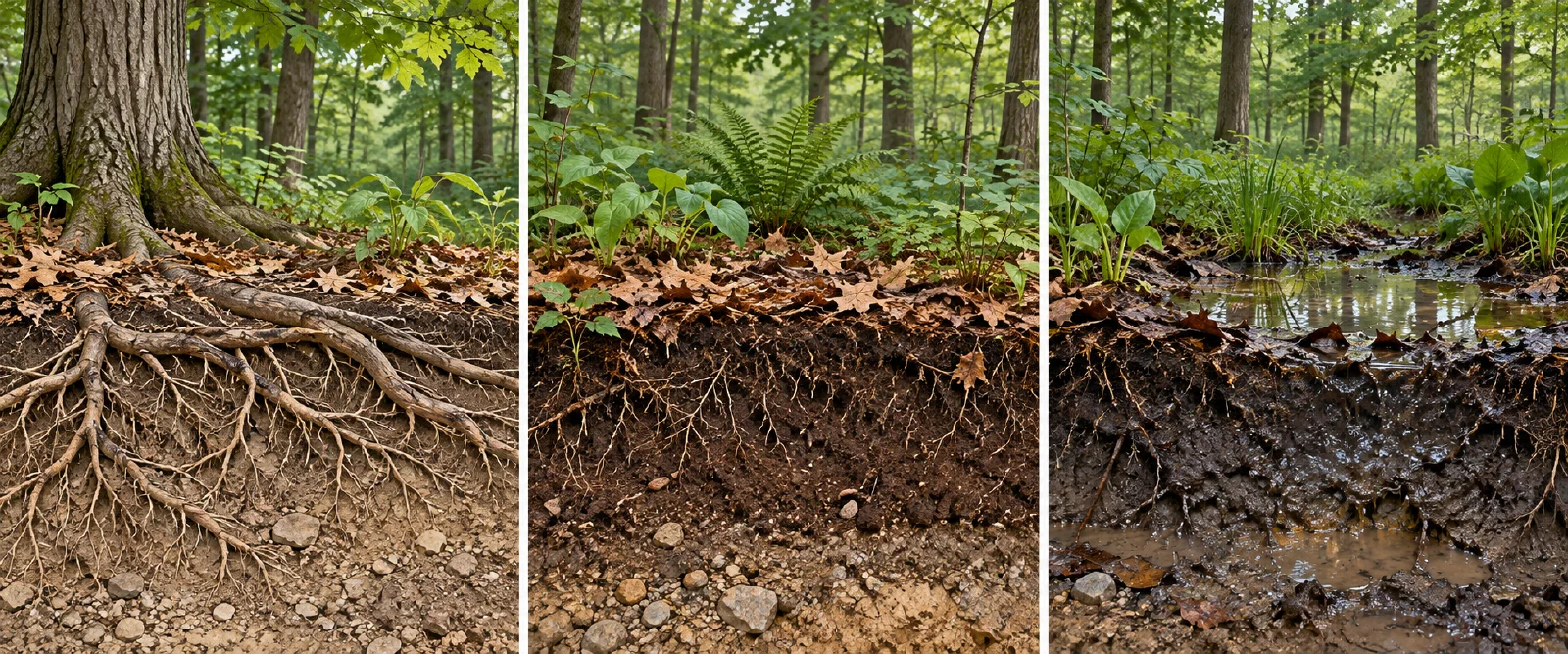
Start by separating three questions: how much light reaches the bed, how wet the soil stays, and which pollinator function you want to support. A moist woodland edge and a dry spot beneath a mature tree are different planting conditions even when both are described as full shade.
Shade examples are starting points, not a statewide recipe
The Penn State York County pollinator guide has a table for a shady garden. It lists, among other examples, jack-in-the-pulpit for moist soil, wild geranium for moist to medium soil, and white wood aster for moist-to-dry conditions. The table is useful for screening bloom and moisture, but its broad shade label and county scope do not prove that every plant will perform in deep shade across Pennsylvania.
Bloodroot is a more specific woodland example. Penn State’s native herbs and pollinators profile describes it for full to partial shade and moist, well-drained soil. Its early flowers supply pollen, not nectar, and the plant can become dormant by mid- to late summer. It can therefore fill an early-season role without serving as a season-long flower source. Do not place it in a saturated bed on the strength of its shade tolerance.
Household safety matters too. Penn State’s native-herbs profile warns that bloodroot is poisonous and can be fatal if ingested in large quantities. If you plant it, keep it safely away from children and pets, as Penn State’s native-plant safety guidance recommends.
| Candidate | What the source supports | What still needs checking |
|---|---|---|
| Bloodroot (Sanguinaria canadensis) | Early pollen in moist, well-drained shade; source also identifies moth-host relationships | County range, actual drainage, and whether its summer dormancy fits the planting |
| Jack-in-the-pulpit (Arisaema triphyllum) | A York County shady-garden example for moist soil | Local range, exact light, and wildlife function for the intended site |
| Wild geranium (Geranium maculatum) | A York County shady-garden example for moist-to-medium soil | County occurrence, dry-season performance, and mature spread |
| White wood aster (Eurybia divaricata) | A York County shady-garden example for moist-to-dry soil | County occurrence and whether the site’s light is sufficient for flowering |
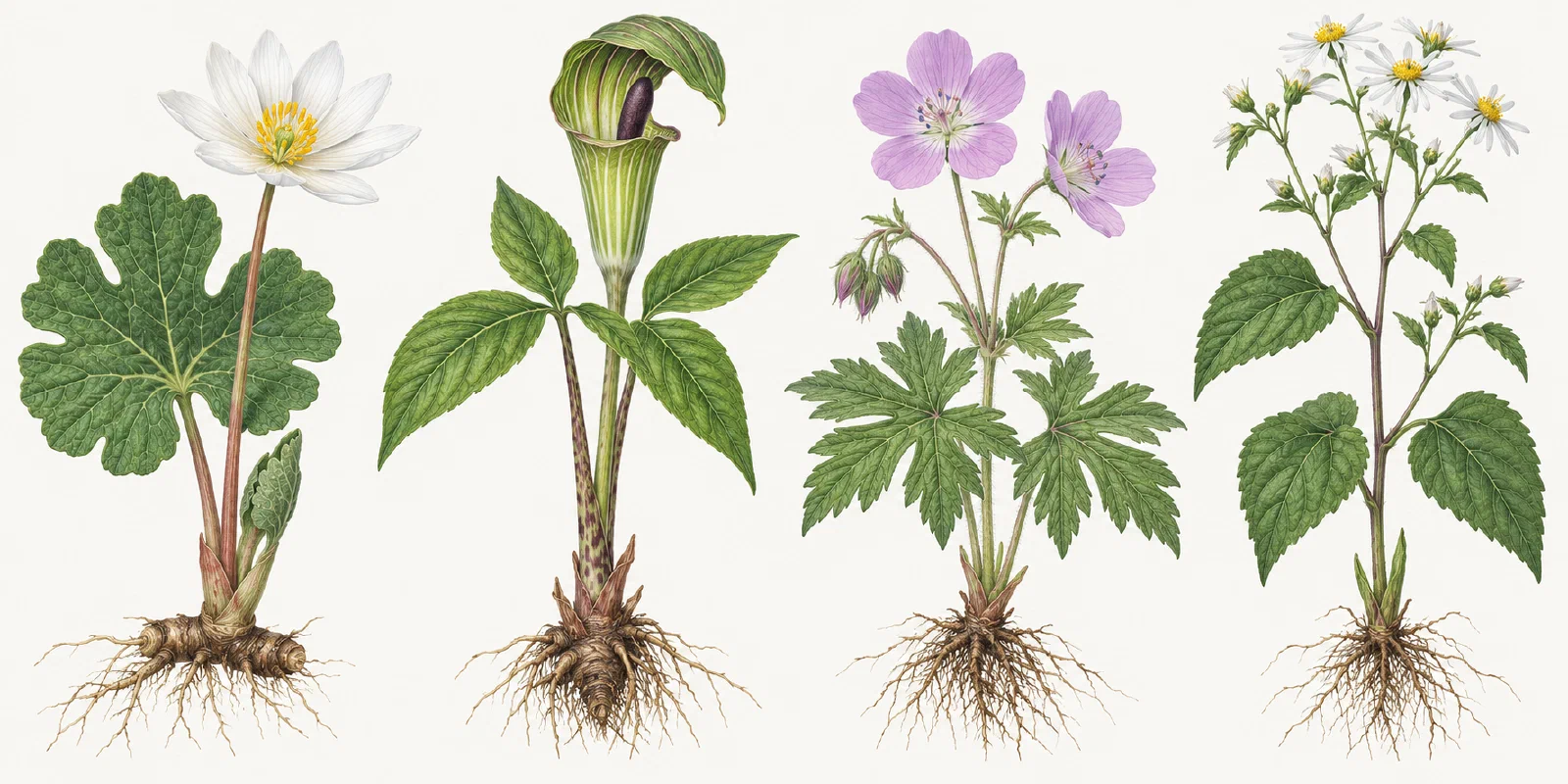
The table is a short list to investigate, not a ranked or complete Pennsylvania catalog. Check the scientific name, local native range, mature size, soil moisture, and the source’s exact light description before buying. An ecoregion or hardiness label does not replace those checks.
Match the pollinator function to the site
“Pollinator plant” can mean nectar, pollen, larval host foliage, or habitat structure. These are different jobs. Bloodroot’s pollen and host relationships, for example, should not be rewritten as a claim that it feeds every pollinator or attracts a particular visitor.
Flowering plants alone may not meet every pollinator need. Penn State’s Pennsylvania wild-bee guidance describes diverse flowers and nesting places as separate habitat components. Many ground-nesting bees use small, exposed patches of well-drained soil in sunny locations, so a fully shaded bed may be a poor place to supply that particular resource. If your yard has a sunny, well-drained edge, it can serve a different role from the shaded bed.
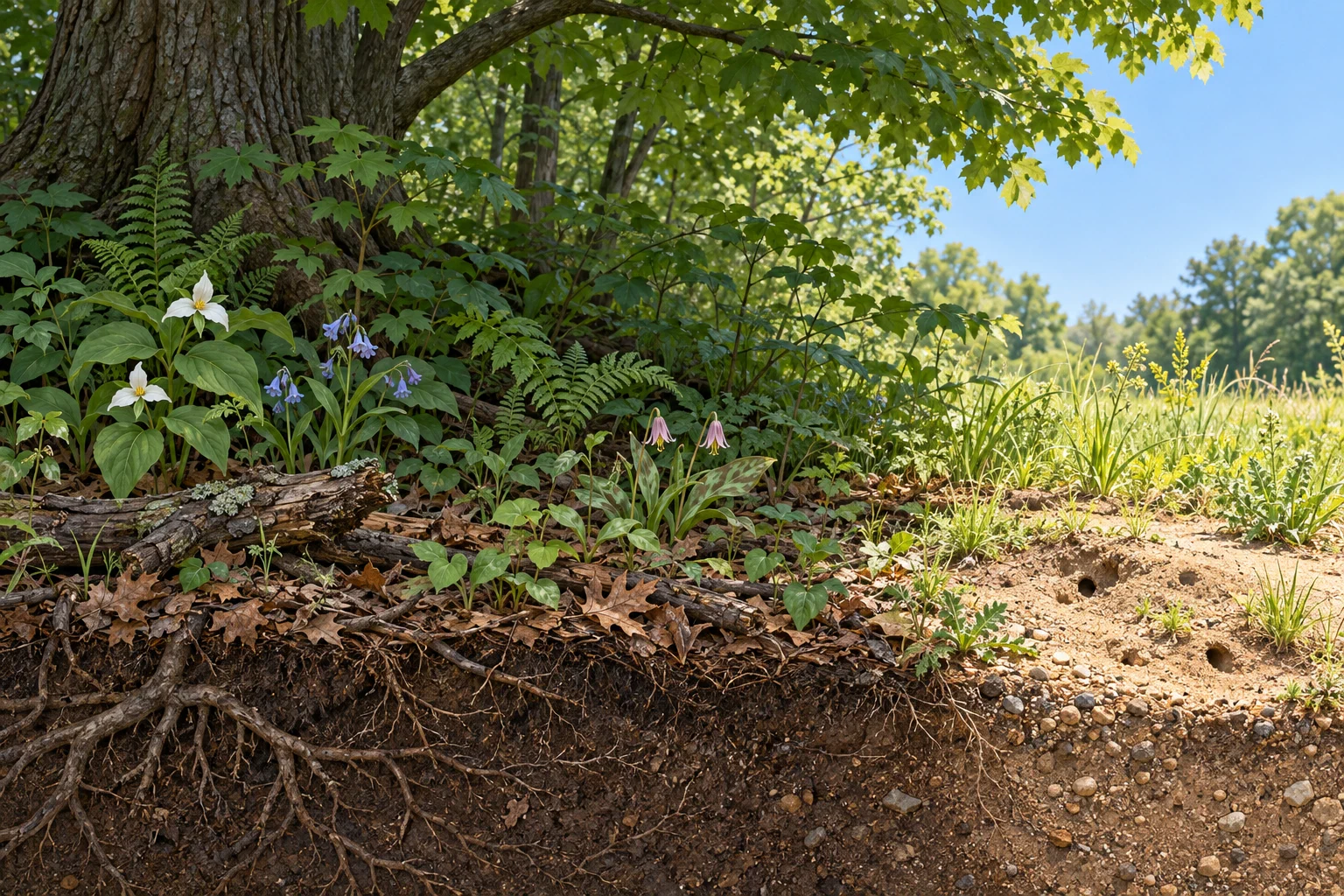
Under a mature tree, a soft landing can add a native shade layer with leaf litter and some fallen branches instead of keeping the entire area as turf or bare mulch. Penn State presents this in its soft-landings guidance as one habitat approach, not a complete plant list. Keep tree health, existing roots, safe access, and local conditions in view before changing the ground beneath a tree.
For the conversion steps and tree-root limits, see how to create a soft landing beneath a Pennsylvania tree.
Build a short, local shortlist
- Identify the Pennsylvania county or ecoregion and confirm each candidate’s local native status.
- Mark the parts of the bed that stay moist, dry between rains, or become waterlogged.
- Compare the source’s light guidance with the actual shade rather than treating “shade” and “full shade” as interchangeable.
- Give each plant a job: early pollen, later bloom, host foliage, ground-layer cover, or another supported function.
- Check the whole planting for seasonal gaps and for habitat features that flowering plants do not supply.
Penn State’s keystone-plant guidance also treats ecological relationships as ecoregion-specific. Its perennial examples that tolerate some shade are not automatically full-shade recommendations. Use them as a reason to check regional relationships, then filter again for light, moisture, and local occurrence.
For broader pollinator habitat planning, see the wildlife garden function checklist. If you are planning a rain garden rather than an ordinary shade bed, use the separate Pennsylvania rain-garden guide.
Sources and further reading
- Native Herbs: A Benefit to Our Gardens and Our Pollinatorsauthoritative-secondary
- Spooktacular Flora and Fungiauthoritative-secondary
- Planting for Pollinators — York Countyauthoritative-secondary
- How to Use the Maps — USDA Plant Hardiness Zone Mapprimary
- Conserving Wild Bees in Pennsylvaniaauthoritative-secondary
- Soft Landings Benefits Insects and Gardenersauthoritative-secondary
- Keystone Species: A Framework for Selecting Native Plantsauthoritative-secondary