Choose wildlife-friendly plants for a Pennsylvania rain garden
Use the wet, moist, moist-to-dry, and drier parts of a Pennsylvania rain garden to screen native plant candidates for site fit and wildlife function.
On this page
A rain garden may provide wildlife habitat while it manages runoff, but the bottom of the bed and its higher edges do not have the same moisture. Penn State Extension’s rain-garden resources organize candidates by preferred moisture zone and recommend considering sun, soil, height, bloom, spread, and wildlife value as well. Use that framework to screen plants, then verify each candidate’s local range and full site fit.
Start with the water pattern
Observe the bed after rain and note where water gathers and how quickly different areas dry. If the soil remains saturated between storms, confirm the site’s hydrology and drainage plan before treating it as a standard rain garden. A wet/moist plant is not automatically suited to permanent standing water, and a plant that tolerates occasional wetness is not a good choice for the lowest spot just because it is native.
| Penn State moisture group | Where it fits in the decision | Representative examples listed by Penn State |
|---|---|---|
| Wet/moist | The consistently wettest position; some plants in this group may struggle where drainage is excellent | Swamp milkweed, turtlehead, buttonbush |
| Moist | Usually moist soil with some drying between wet periods | Virginia bluebells, spicebush, elderberry |
| Moist/dry | A position that alternates between wetter and drier conditions | Wild geranium, obedient plant, winterberry |
| Dry | Better-drained upper edges that may get wet occasionally | Butterfly weed, purple coneflower |
These are screening examples, not a complete native-plant list or a guarantee for every Pennsylvania county. Check the individual plant information for light and mature size. For example, a plant in the “moist” group may still need more sun than your bed receives, and obedient plant can spread by runners in moist conditions.
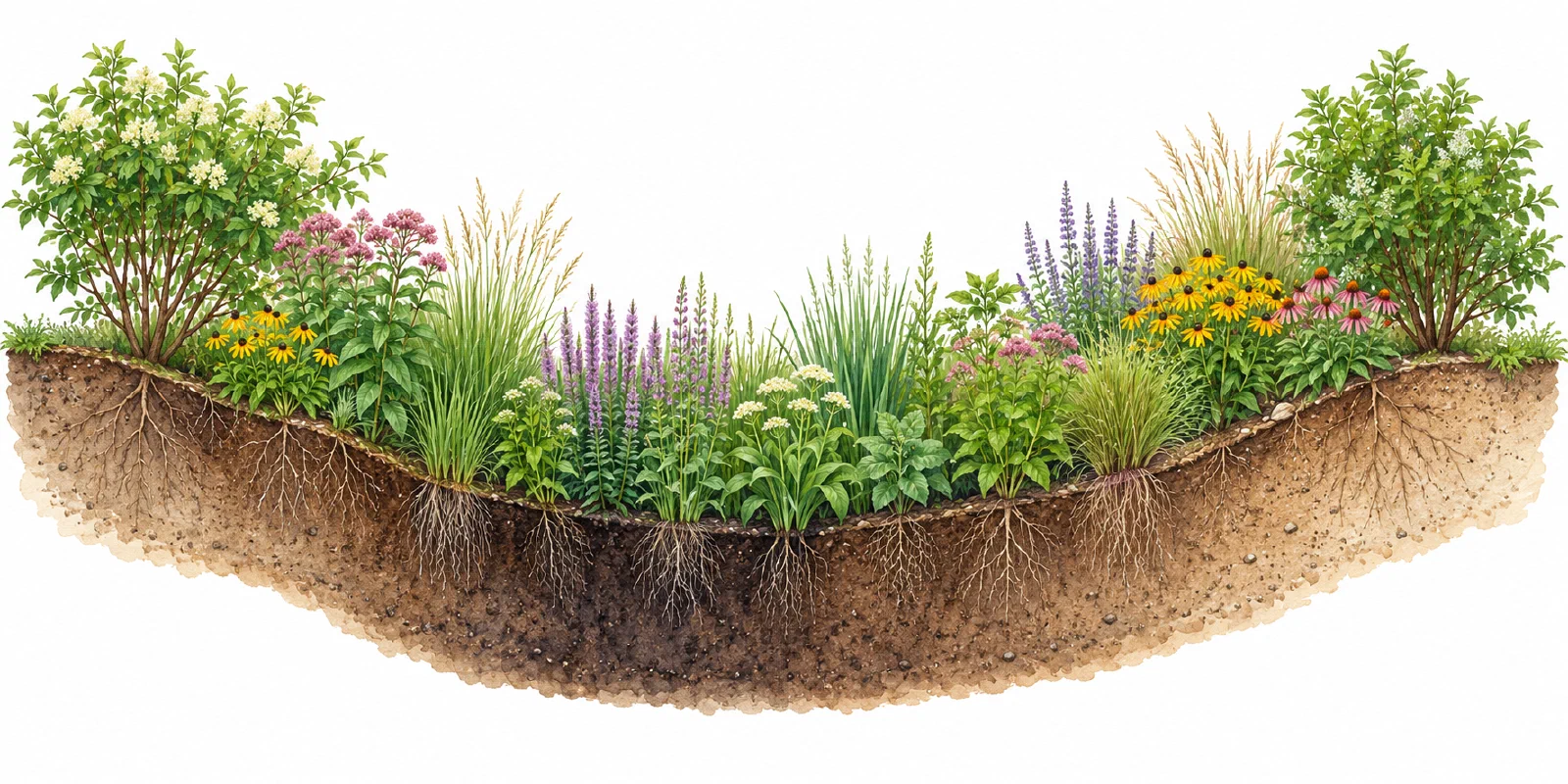
Conceptual moisture gradient only; observe your bed’s wetness and drying pattern. This illustration is not a drainage or basin design.
Keep wildlife value separate from water tolerance
Plants may provide flowers or seasonal food, but a rain garden does not support wildlife simply because it holds water. Penn State’s guidance describes plants as providing habitat for pollinators and other wildlife; the actual function depends on plant identity, bloom, structure, and surrounding habitat. If the goal is pollinators, check for more than one bloom period and consider whether nesting or overwintering resources are present elsewhere in the yard.
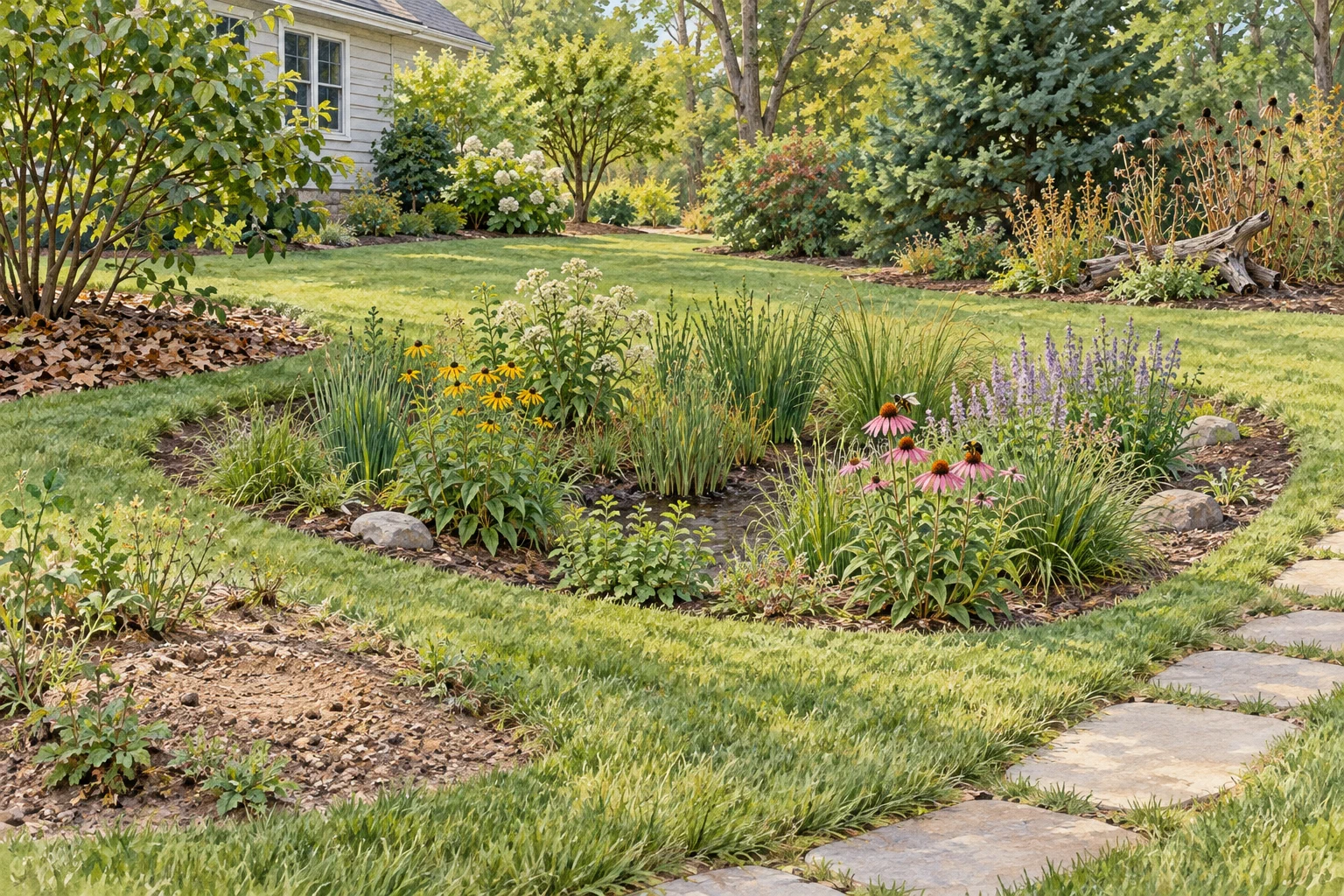
Nesting and overwintering resources can be elsewhere in the yard; this view is not a site plan.
Think of the planting as a set of site-fit decisions:
- Match each position to its observed moisture pattern.
- Filter candidates again by sunlight, soil, mature height, spread, and native range.
- Decide which wildlife function each candidate actually supplies.
- Leave room to identify young plants and monitor spread as the garden establishes.
- Revisit the planting after heavy rain and through different seasons.
Know when a plant list is not enough
Rain gardens are designed to manage water, so a species table cannot tell you whether a particular basin is correctly sized, located, or connected to runoff. Penn State’s introduction to rain gardens directs readers to site assessment and local Extension resources for those questions. Check municipal requirements and underground utilities before digging, and get site-specific help if water threatens a building, septic system, drain, or neighboring property.
For a broader explanation of habitat functions, see the wildlife garden function checklist. For a Pennsylvania planting where deep shade rather than runoff is the main constraint, see pollinator plants for zone 6 full shade.
Sources and further reading
- Rain Garden Resources from Penn State Extensionauthoritative-secondary
- An Introduction to Rain Gardensauthoritative-secondary