A buyer's checklist for native seeds and plants
Prepare a short, site-specific brief for comparing native-plant offers, seed lots, health practices, availability, and shipment details.
On this page
Use this brief to compare an offer with your actual planting goal. The questions are prompts, not a universal label requirement: what a seller can document depends on the product and jurisdiction.
Before you contact a seller
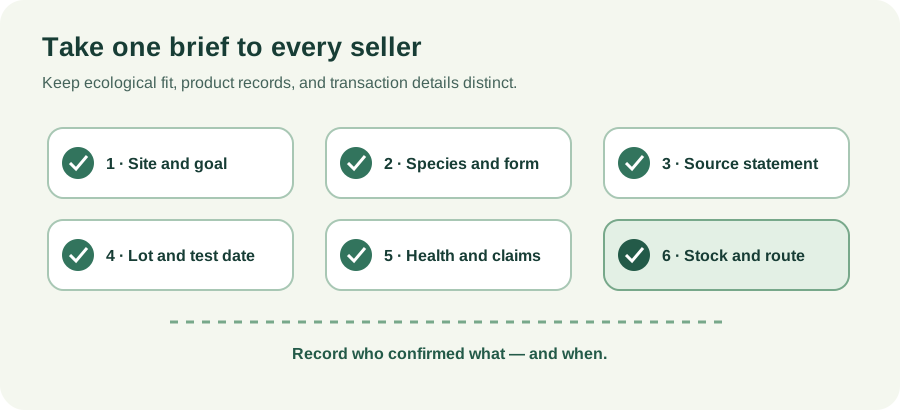
- Planting place: state or province, county or municipality if useful, and whether the location is a yard, community project, or restoration site.
- Site: light, soil texture, drainage, moisture through the season, space, and the job you want the planting to do.
- Identity: scientific name, seed mix components, stock form, and any cultivar or substitution.
- Source: where parent material was collected or seed produced, whether stock was nursery-propagated, and what the seller means by “local,” “grown here,” or “source-identified.”
- Lot and quantity: lot number, harvest or packing year, available purity and germination results, test date, and amount needed for the intended planting.
Questions for the offer
Ask what evidence supports the plant’s regional range and its fit for your site; a seller’s listing or a native label does not answer both. For a mix, request every species and its share. For nursery stock, ask about the specific lot’s condition, growing medium, pest monitoring, and how the seller handles a problem found before shipment. If pollinator value matters to you, ask whether a systemic insecticide was used and which product; the answer is supplier- and lot-specific.
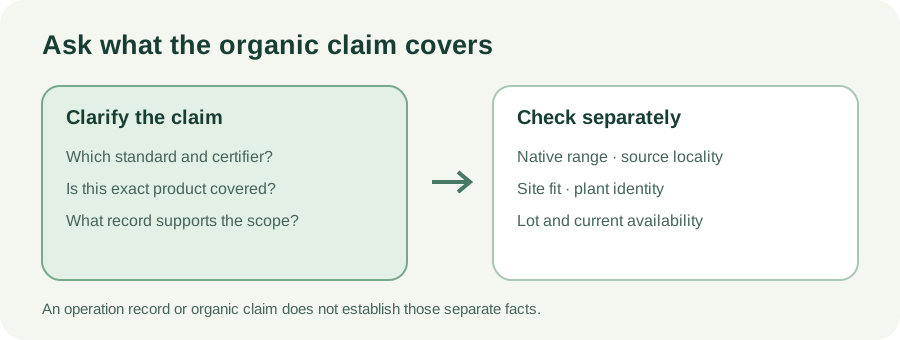
If a seller uses an organic claim, ask which standard and certifier apply and whether the exact product is within that scope. An operation-level database entry is a lead, not proof that every plant or seed lot is covered. Organic status does not establish native range, source locality, or garden fit.
Confirm the transaction
Check live quantity, substitutions, price, pickup or delivery, and the date each detail was confirmed. Before a cross-border order, verify the exact product, origin, destination, use, and route with current agency tools. Do not collect seed or plants from land without permission and a local status check; access to a site is not permission to remove material.
Keep the product name, supplier answer, lot information, and order date together. If one of them changes, repeat the checks that depend on it. The online seed guide, stock-health guide, and shipment guide cover those questions in more detail.
Sources and further reading
- Where to Buy Native Plantsprimary
- Wildflowersauthoritative-secondary
- Strengthening Organic Enforcement Frequently Asked Questionsprimary
- Organic productsprimary