How to check native nursery stock before buying
Ask about the offered lot's condition, monitoring, growing media, treatment history, and the limits of nursery health claims.
On this page
A plant can look healthy at pickup and still carry a hidden pest, while a nursery’s health program does not establish native range or site fit. Ask about the actual lot and the practices behind a claim rather than relying on a broad “clean” or “native” label.
Inspect the offered stock and ask how it is monitored
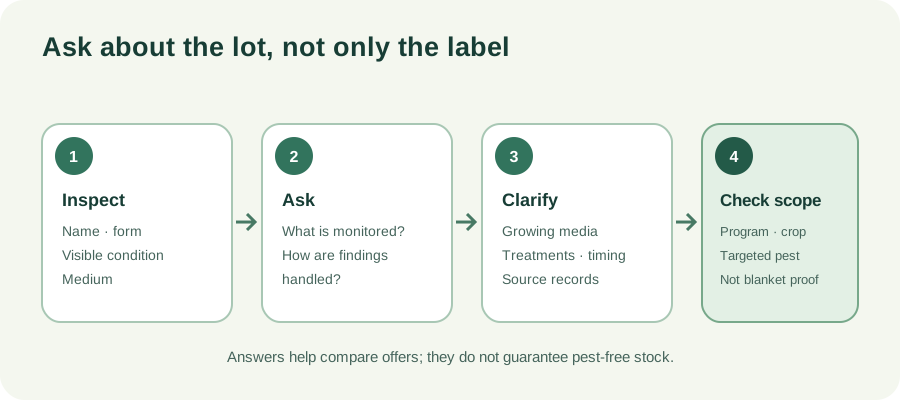
Check the name, stock form, leaves, stems, roots visible at the pot edge, and growing medium. Look for obvious damage or pests, but treat a quick visual check as a screen, not a diagnosis. Ask how incoming material is checked, what pests are monitored for that crop and season, how findings are handled, and whether the seller can trace the lot to its source.
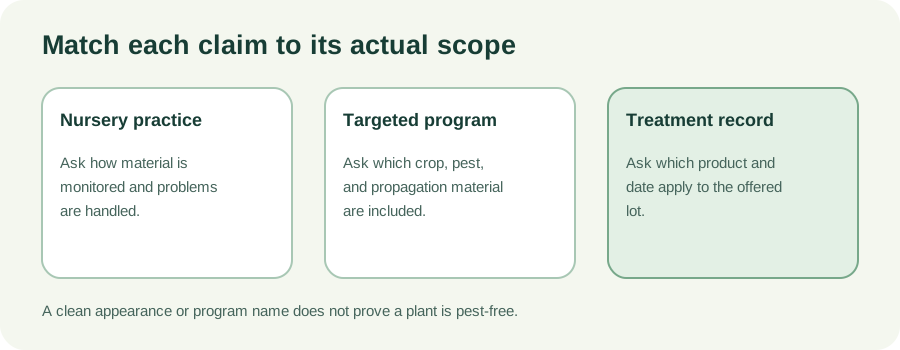
CFIA’s nursery biosecurity guidance is voluntary and operation-specific. It describes prevention, monitoring, and response practices; it is not a certificate that a particular seller follows them. A targeted clean-plant program may address named crops or pests, not every native perennial or organism. Ask which program, crop, and material a supplier’s claim covers.
Growing media can matter too. Soil or potting mix may carry organisms that are difficult to see, so ask how plants and containers are handled and whether any locally relevant pest precautions apply. Do not bare-root or rinse a plant on the assumption that this is always safer; handling can stress roots and recommendations depend on the plant and local guidance.
Ask about treatment when pollinator value matters
If you are choosing flowering plants for pollinators, ask whether the lot was treated with systemic insecticides, which product was used, and when. A Maine Extension buyer guide recommends asking about systemic neonicotinoids when labels do not say. A controlled enclosure study found reduced foraging and reproduction for one solitary bee after one imidacloprid treatment on potted ornamentals. Its result does not establish treatment at a named nursery or predict effects for every plant, pesticide, bee, or garden.
Record the supplier’s answer with the plant and lot details. For source, regional status, and order checks, use the buyer checklist.
Sources and further reading
- National Voluntary Farm-Level Biosecurity Standard for the Greenhouse, Nursery and Floriculture Sectorsprimary
- Nursery Sector Biosecurity Guideprimary
- What are the reasons you should buy native plants from a nursery rather than a box store?authoritative-secondary
- Pollinators and plant nurseries: how irrigation and pesticide treatment of native ornamental plants impact solitary beesprimary
- National Clean Plant Networkprimary