Buying native seeds online: identity, origin, and risk checks
Check every species in an online native-seed listing and compare the delivered packet with the order before sowing.
On this page
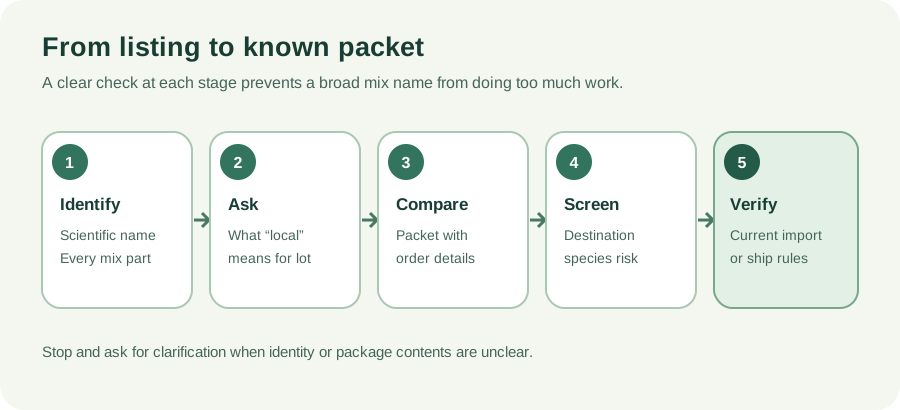
An online listing can make seed look simple to compare, but a broad name such as “native wildflower mix” may hide which species are included. Before ordering, decide what you want to plant and check the exact species and destination.
Check the listing before paying
Look for the scientific name of each species, not only a common name or a broad mix label. Ask where the seed was collected or produced, and whether “local” refers to the parent material, the growing site, or only the seller. Those details help you evaluate origin; they do not prove local adaptation, garden fit, or current availability.
The Canadian Food Inspection Agency advises buyers to identify seeds by scientific name and check that the delivered package contains the species ordered and no unlisted species. A generic mix without a component list makes that check difficult. Pause if the seller cannot identify what is in the packet or the name is too vague to check.
Check the destination and delivered packet
If seed is being shipped into the United States from another country, follow current APHIS guidance for online plant and seed imports to check whether the exact item needs a permit or exemption and what shipping steps apply. For a Canada-bound seed shipment, check the exact species, origin, destination, and use through CFIA import guidance. A website that accepts an order does not establish that a seed is safe or eligible to enter the country.
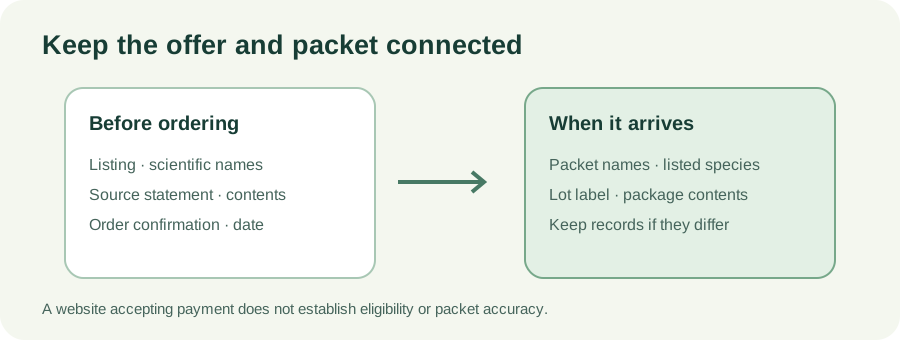
When the packet arrives, compare its label with the listing and order confirmation. Keep the lot or package information if something differs. For component percentages, test dates, and certification language, use the seed-mix label guide; for a cross-border order, see the shipment check.