Troubleshooting & Site Diagnostics
Native plants declining in wet clay soil in Michigan
Investigate plant decline where wetness and clay may overlap with compaction, planting history, or other causes in Michigan.
On this page
Clay and a wet spot are clues, not a diagnosis. Water can linger because of land shape, compacted or altered soil, a restrictive layer, or a drain. Another plant-health problem may also contribute. Record the pattern before changing the site.
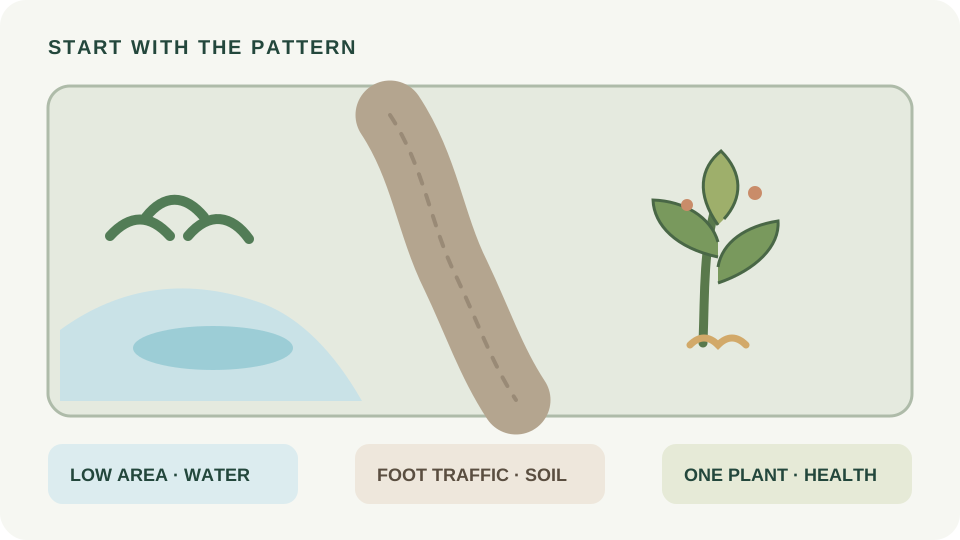
Record what changed
Identify the plant if possible. Note when decline began, which parts are affected, how many plants are involved, and whether damage follows a low spot, traffic, construction, or only one plant. Add planting, grading, pruning, watering, and weather history. Compare with a healthy plant of the same kind when available.
After rain, note where water collects and how long it remains; repeat in a drier period. Ponding, slow water movement through soil, and compaction can be related, but one does not measure the others. Surface appearance is not a root-zone measurement.
Compare explanations
Check a Michigan-region profile for the identified plant’s light and moisture fit. Wet roots, drought, planting depth, disturbed soil, winter injury, animals, insects, or disease may contribute; causes can overlap.
The USDA Natural Resources Conservation Service defines infiltration as water entering soil. Texture, moisture, compaction, and structure affect it, so surface appearance does not measure infiltration. A standard fertility test does not diagnose every physical soil or plant-health problem.
Choose a next step
For a mild, stable pattern, keep dated observations across weather. Use a Michigan soil-testing service for chemistry questions and follow its instructions. For persistent decline or uncertain identity, contact local extension or a plant clinic; prepare the history and photos first. If water affects a foundation, utility, neighbor, or engineered feature, get qualified local advice before changing drainage. Do not excavate roots or redirect runoff from a symptom. See winter-damage clues.
Sources and further reading
- Diagnosing a Plant Problem 101authoritative-secondary
- Soil Quality Physical Indicator Information Sheet Series: Infiltrationprimary
- Soil Testsauthoritative-secondary