Troubleshooting & Site Diagnostics
Before you seek a plant diagnosis: what to record and photograph
Build a concise plant-health history and photo set for a local extension office or diagnostic service.
On this page
A useful plant-health question starts with what changed, where, and what has already been tried. That history helps a diagnostic service decide what information or sample may help. Photos do not guarantee a diagnosis; each service sets its own submission requirements.
Build a short timeline
Note plant identity, location, onset, and whether the change is spreading or stable. Describe the affected parts and number of plants involved. Note recent weather, watering, planting, pruning, fertilizer or pesticide use, construction, flooding, and light changes. Separate observations from guesses: “leaves yellowed after heavy rain” is more useful than an unconfirmed diagnosis.
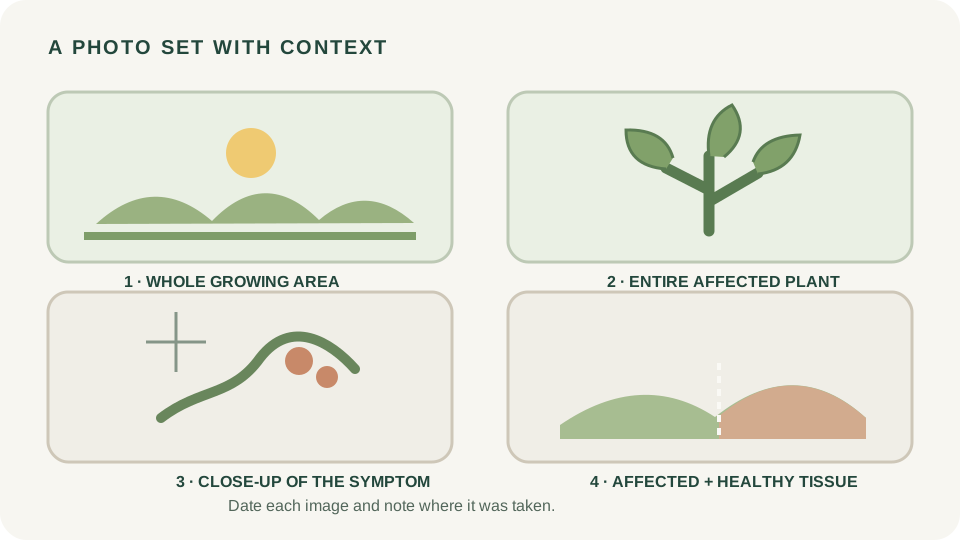
Compare the affected plant with a healthy plant of the same kind, if available. Note whether symptoms follow a slope, wet area, path, shade edge, or row. Date each photo and identify where it was taken so images from different weeks or plants are not confused.
Take useful photographs
Photograph the whole planting, the entire affected plant, a close-up, and affected and apparently healthy tissue together. Use ordinary light and enough context to show where the close-up came from. Avoid filters. For a tall plant, include more than one height; if symptoms vary, show typical and unusual examples.
Match a sample to the service
Contact the receiving service before collecting or mailing material; it may set requirements for parts, amount, packaging, timing, fees, and forms. Follow its instructions; an unsuitable sample may not answer the question. A soil test answers only the fertility or pH questions it measures; it cannot identify every disease, insect, drainage, compaction, or shade problem. Ask the service which test fits before submitting soil.
For continuing decline, contact local diagnostic help. For a suspected regulated pest, follow the official reporting guide and its organism-specific directions, which may include a capture step. Do not move potentially infested plants to another site or mail or discard a specimen unless the authority directs you. Keep original photos and notes.
Sources and further reading
- Diagnosing a Plant Problem 101authoritative-secondary
- Soil Testsauthoritative-secondary