Planting Under Mature Trees
Consider light, moisture, roots, and tree health before planting beneath an established canopy.
On this page
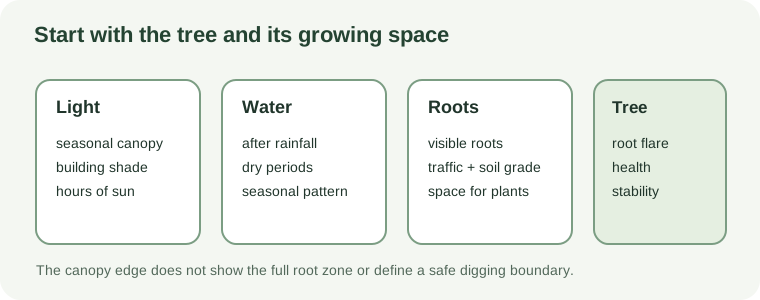
The ground beneath a mature tree may be shaded, dry, seasonally wet, compacted, or some combination of these. Tree roots use water and occupy the same soil where new plants would grow. Begin by deciding whether a planting is compatible with the tree and site; finding a shade-tolerant species is only one part of that decision.
Observe before disturbing the soil
Notice when the tree canopy blocks light, how much rain reaches the ground, and whether moisture changes after leaf-out or during dry weather. Look for visible roots, a clear root flare where the trunk widens into roots, bare or stressed patches, and places where people or equipment cross the root area. Root distribution varies with tree, soil, and site history; it cannot be mapped reliably from the canopy edge alone.
Established roots can be damaged by digging, cutting, traffic on wet soil, or raising and lowering grade. Penn State Extension’s underplanting guide advises removing turf carefully with hand tools, avoiding exposed-root cutting, and not covering the root flare or burying the root area under a large volume of soil or compost. Treat its recommendations as practical guidance for a specific site, not a universal root-distance map.
Choose a low-disturbance option
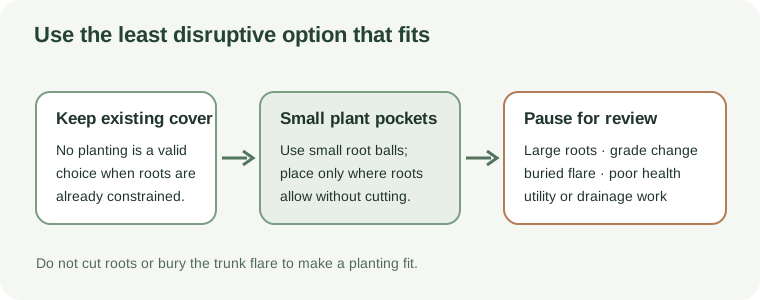
If the tree is healthy and the site has room for compatible plants, start with a few small planting pockets rather than extensive cultivation. Small plugs or divisions are easier to place between roots than large plants needing wide holes. Use locally appropriate species that match the measured light and moisture. Do not force a plant into a pocket that contains a large root or requires changing the grade.
Protect the visible trunk flare and avoid piling mulch against the trunk. Penn State’s mulching guide recommends spreading an appropriate layer broadly rather than mounding it at the trunk; poorly drained soil and fine mulch can require less. Follow current local tree-care advice for depth and placement.
When not to plant yet
Do not cut roots or add soil to make a plant fit. If the root flare is buried, the tree is declining or unstable, roots are exposed across the proposed area, construction or utility work is planned, or drainage would need to change, seek a qualified arborist or the relevant local authority before proceeding. A small understory planting can still affect water and root competition, and no planting is a valid choice when disturbance would add risk.
For plant examples suited to Virginia dry shade, see the regional dry-shade guide. Use the site assessment worksheet to record shade, seasonal moisture, tree condition, soil grade, and intended use before choosing a candidate.
Sources and further reading
- Underplanting Trees — Respect the Rootsauthoritative-secondary
- Mulching Landscape Treesauthoritative-secondary
- Where the tree roots growspecialist