Native Plants for Dry Shade in Virginia
Assess light, seasonal moisture, tree roots, and local range before screening Virginia plants for dry shade.
On this page
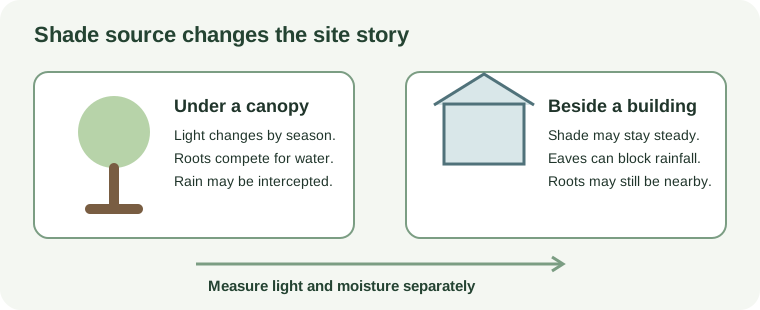
Dry shade combines limited light with limited or uneven soil moisture. Under a tree, roots compete for water and the canopy may intercept rain; beside a building, an eave can keep rain off a bed even when no tree is present. A plant described as shade-tolerant is not automatically suited to dry soil, and a dry-shade label does not establish that it is native to your part of Virginia.
Observe light and water as separate conditions
Watch the area at different times of day and, where possible, before and after the tree canopy leafs out. Note whether shade comes from a tree, a wall, or a roof overhang. Check the soil after rainfall and during a dry spell. A slope, shallow soil, dense canopy, or nearby pavement can change the water pattern; shade alone cannot explain it.
Under established trees, roots take up moisture and can be damaged during bed preparation. The guide to planting under mature trees covers low-disturbance options. If the planting area has persistent erosion, exposed roots, or a tree-health concern, pause before changing grade or trying to hold soil with a plant list.
Treat examples as leads, not a statewide palette
Virginia Cooperative Extension’s 2026 landscape guide names white-tinged sedge (Carex albicans), Robin’s plantain (Erigeron pulchellus), and Christmas fern (Polystichum acrostichoides) as groundcovers to consider for erosion prevention in dry shade, such as beneath a tree. The guide does not provide measured slope-control results or establish that each species fits every Virginia county, soil, or canopy. Use the examples to begin a local check, not as a guarantee.
Box huckleberry (Gaylussacia brachycera) is another bounded example in a Virginia Extension profile: it is described as a slow-growing evergreen groundcover for partial to full shade, with well-drained, acidic soil. That profile does not establish county-level Virginia range, clay or compaction tolerance, or performance in prolonged saturation. A dry-shade candidate still needs the right soil and water conditions.
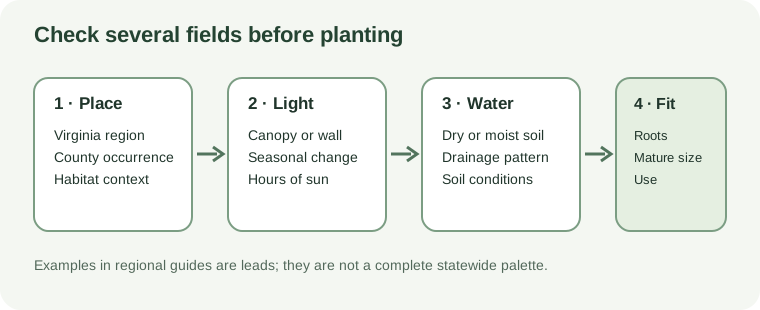
Check a candidate’s range in the Digital Atlas of the Virginia Flora and compare its habitat with the site. The Virginia Department of Conservation and Recreation regional guides add coastal, Piedmont, and mountain context. A map or regional brochure narrows the question; it does not replace checking the actual bed’s light, moisture, soil, and available space.
Build a shortlist around the whole site
For each candidate, record local range, light, moisture, drainage, mature height and spread, and the role you want it to fill. Check whether tree roots, a roof edge, or nearby pavement creates a second constraint. Avoid adding soil over roots or cutting roots just to make a plant fit. If no candidate matches the observed conditions, keep the area unplanted, use a container, or reconsider the layout rather than forcing a poor match.
Use the site assessment worksheet to record conditions and compare candidates. For establishment and later care, follow current regional guidance; a dry-shade list does not supply a universal watering schedule or promise survival.
Sources and further reading
- Native Plants in the Landscape: Incorporating Native Plantsauthoritative-secondary
- Selecting Plants for Virginia Landscapes: Edible Landscape Species — Shrubs, Vines, and Groundcoversauthoritative-secondary
- Digital Atlas of the Virginia Floraspecialist
- Native Plants for Conservation, Restoration and Landscapingprimary
- Underplanting Trees — Respect the Rootsauthoritative-secondary