Pennsylvania Native Groundcovers for Sunny Slopes
Compare Pennsylvania Extension groundcover examples for slopes by rooting role, spread, seasonal form, salt evidence, and first-year establishment.
Penn State Extension describes several groundcovers for difficult landscape situations, including sunny slopes where runoff and erosion are concerns. The examples differ in growth form and establishment. Use the table to identify what each source-backed candidate may contribute, then check local range and the actual soil, light, and moisture at the slope. The source does not establish that every candidate is native to every Pennsylvania locality.
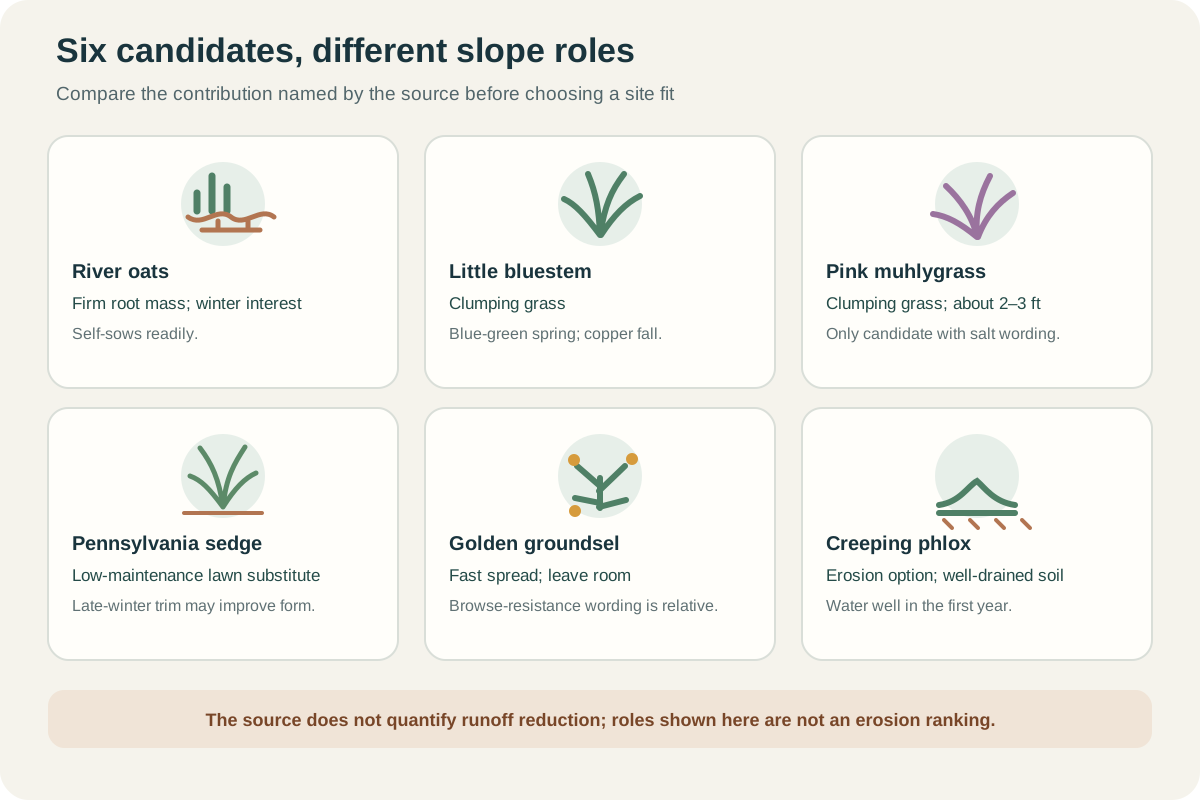
The roles reflect source-described contributions, not a ranking of erosion control or a prediction of cover.
| Candidate | Supported role or trait | Fit and limits to check |
|---|---|---|
| River oats (Chasmanthium latifolium) | Penn State identifies it as very good for slopes, with a firm root mass and winter interest. It can self-sow readily. | Allow for seedlings beyond the original planting. The cited comparison does not provide a local range or a universal salt rating. |
| Little bluestem (Schizachyrium scoparium) | Forms clumps; foliage is blue-green in spring and turns copper in autumn. It can reseed. | Clumping form differs from a continuous mat. The source does not make a salt-tolerance claim for it. |
| Pink muhlygrass (Muhlenbergia capillaris) | Clumping stems reach about 2–3 feet; the source describes heat, drought, poor-soil, and salt tolerance. | The salt statement has no dose or exposure duration. Keep clump size and the source’s qualitative tolerance separate from a roadside guarantee. |
| Pennsylvania sedge (Carex pensylvanica) | Penn State presents it as a low-maintenance lawn substitute; a late-winter cut or mow to about 3 inches can improve its appearance. | A lawn-substitute role does not establish rapid slope coverage or fit for every sunny exposure. Check local light and moisture. |
| Golden groundsel (Packera aurea) | The source describes fast spread and deer- and rabbit-resistant behavior. | The browse label is relative, and rapid spread needs room. The source does not establish a particular slope’s soil or drainage fit. |
| Creeping phlox (Phlox stolonifera) | Penn State includes it as an erosion option for well-drained soil. It should be well watered in its first year and is drought tolerant afterward. | The first-year watering guidance matters on an exposed slope. Its stated well-drained fit does not cover sites that stay saturated. |
Plan for cover and establishment
Do not infer that the plants are interchangeable because they appear in a groundcover comparison. A clumping grass, a spreading perennial, and a low sedge make different kinds of cover. Some candidates self-sow or spread quickly; mark the area they can occupy. Penn State also emphasizes site and soil preparation and advises against relying on a single-species planting because one pest or disease could affect the whole stand. Its spring or fall planting guidance applies to many groundcovers, but timing and water needs should still be matched to the selected species and local conditions.
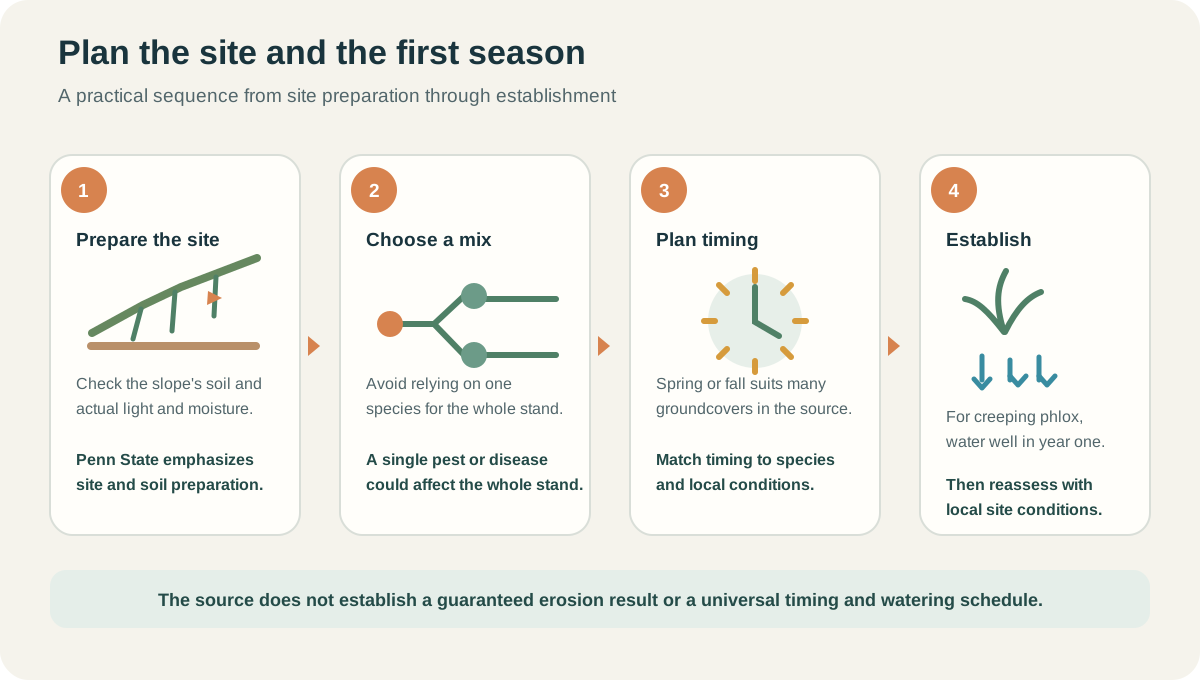
The first-year watering note is specific to creeping phlox; timing and care should still fit the chosen species and local conditions.
These examples do not quantify how much runoff a planting will control, establish county-level occurrence for each species, or provide a common scale for salt tolerance. Where salt spray is a concern, only pink muhlygrass has a salt-tolerance statement in this comparison, and it remains unquantified. Confirm the site and plant source before choosing a mix.
Sources and further reading
- Native Groundcovers Can Solve Tough Challenges in the Landscapeauthoritative-secondary