Plant Communities & Habitat Design
Virginia rain-garden community design
Plan a Virginia rain-garden community around wet-to-dry conditions, layered plant roles, and carefully checked local native status.
A Virginia rain garden must handle both occasional flooding and dry periods, but those conditions do not identify a ready-made species mix. Map the site’s water path and sun first, then check every candidate for local native status, invasiveness, mature size, and actual moisture fit.
Use the Virginia framework carefully
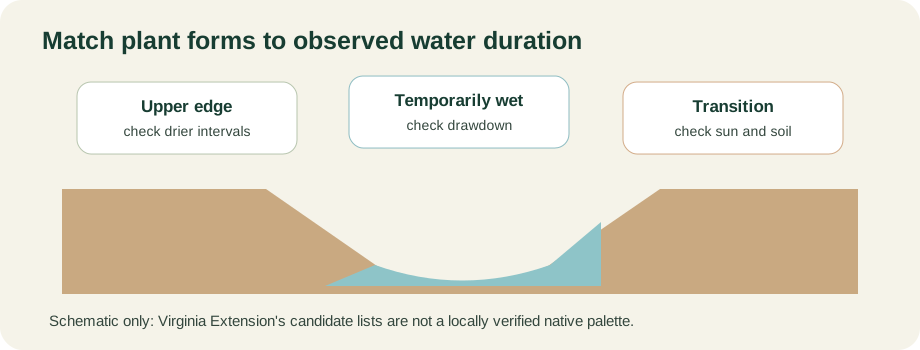
Virginia Cooperative Extension recommends mixing plants with different forms and sizes, including woody and herbaceous plants, and matching them to the garden’s wet-to-dry conditions. Its publication offers one species per 10–20 square feet as a rule of thumb, not a requirement or a verified native palette. The publication’s lists combine native and non-native taxa and do not map each plant to a moisture zone, so do not copy a list as a Virginia-native recipe.
Observe where water enters and where it can overflow. Compare the wet center, transition, and upper edge with the site’s sun, soil, and mature planting space. Keep tall and spreading plants away from access paths and avoid placing a moisture-loving plant where the soil dries quickly. If the project changes drainage or requires an engineered basin, check local stormwater guidance before planting.
Choose locally native, noninvasive candidates from an authoritative Virginia source, then verify county or ecoregion range and site fit. Grouping several of the same plant can make a design easier to read, but spacing still depends on mature dimensions and maintenance access. Leave gaps open rather than filling them with an unverified species.
For a Pennsylvania comparison, see the residential rain-garden community guide. For a method that applies across site types, see how to adapt a native plant community.
Sources and further reading
- Rain Garden Plantsauthoritative-secondary
- Native Plants in the Landscape: Incorporating Native Plantsauthoritative-secondary