Plant Communities & Habitat Design
Residential rain-garden community for Pennsylvania
Use observed water movement to plan a Pennsylvania rain-garden community with qualified wet, transition, and upper-edge plant roles.
On this page
A rain garden is more than a wet planting bed. Its useful plant roles depend on where runoff enters, how long water remains, how the soil drains, and where excess water can go. In Pennsylvania, observe those patterns before choosing plants; a rain garden is not automatically an engineered bioretention system.
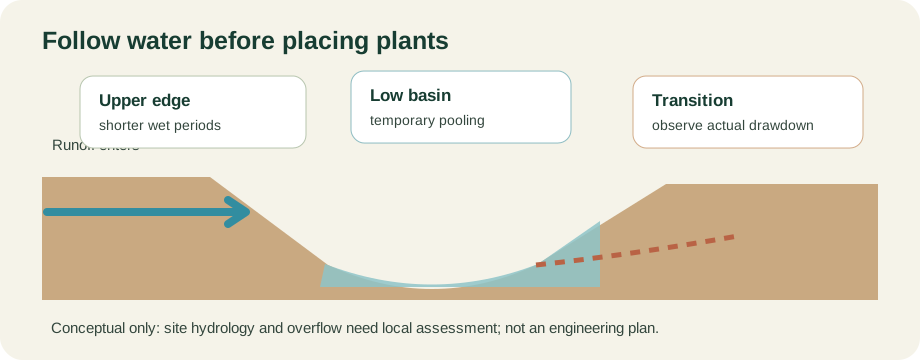
Read the water pattern
After rain, note the inflow point, the lowest area, the edge, and the route water takes when the garden fills. Check sunlight, soil, slope, and mature space for each zone. A rain garden may temporarily collect and filter runoff; engineered bioretention can include design features such as an underdrain. Local terminology varies, so get qualified help when the project changes drainage, needs an overflow plan, or is subject to municipal rules.
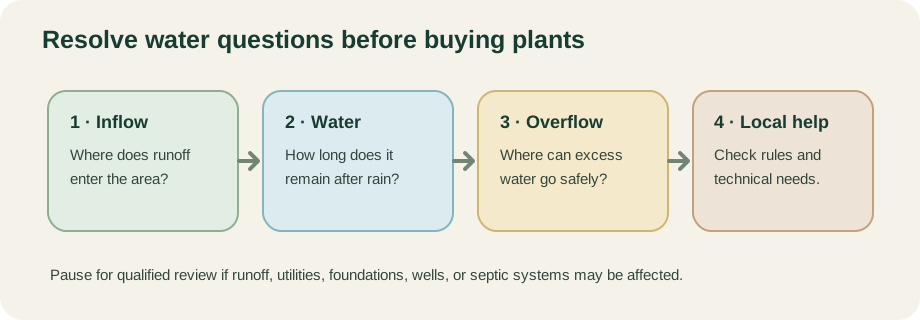
Match roles to the zones
Use plant profiles as examples, not a complete Pennsylvania palette. Penn State describes swamp milkweed as a wet-to-moist plant that can tolerate occasional flooding, while its wild bergamot profile places that species in sunny, moist-to-dry conditions rather than inundation. Both still need a local range, mature-size, and site-fit check; neither species by itself makes a community.
Keep the basin, transition, and upper edge visually connected, but do not force the same plants across all three. Leave enough room for mature spread and for access to the inlet and overflow. If water stays longer than expected, soil is heavily compacted, or runoff could affect a foundation, well, septic system, or neighbor, pause and get local technical advice before planting.
For a compact site, a downspout planter may be an alternative, but its overflow also needs a safe destination. See how to adapt a native plant community for a broader site-to-role method and Virginia rain-garden design for a different regional framework.
Sources and further reading
- Types of Green Infrastructureprimary
- Rain Gardensauthoritative-secondary
- Rain Garden Plants: Swamp Milkweedauthoritative-secondary
- Rain Garden Plants: Wild Bergamotspecialist
- Downspout Planters for Residential Stormwater Managementauthoritative-secondary