Source-identified seed versus local ecotype
Compare the NRCS Source Identified release class with a seller’s local-ecotype claim, and learn what source records and seed-zone tools can show.
On this page
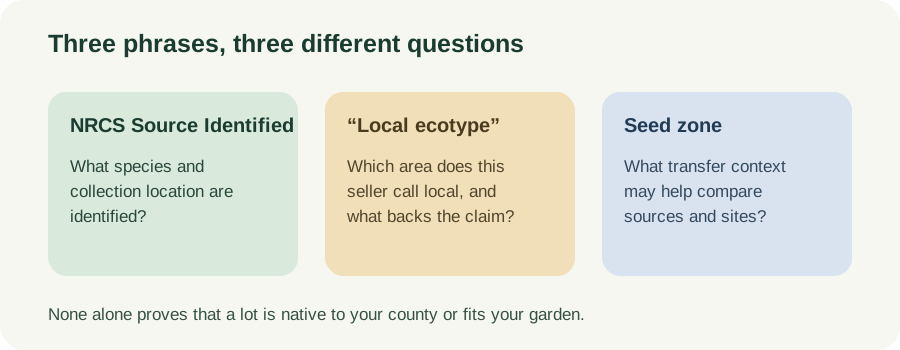
“Source Identified” has a defined meaning within the USDA Natural Resources Conservation Service (NRCS) Plant Materials Program. “Local ecotype” is also used in plant sales, but it does not by itself tell you which program or geographic boundary the seller means.
What the NRCS class says
NRCS Source Identified releases name the species and collection location for an indigenous ecotype; the program does not scientifically evaluate that release class. Other NRCS classes describe different levels of comparative evaluation: Selected releases have desirable traits with minimal test data, Tested releases have more testing, and Cultivars have heritable traits evaluated across their recommended area. These are NRCS program terms, not a universal retail label system.
Ask what “local” means here
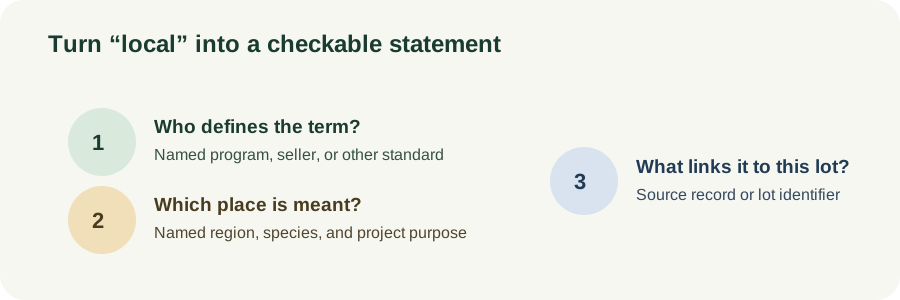
For a seller’s “local ecotype” description, ask which place is meant and how the plant or seed is linked to it. Useful details may include the species, collection region, source record, lot identifier, propagation history, and the purpose for which the source was considered local. A nearby nursery address or a state name alone does not establish where the parent material was collected.
Seed zones can help frame transfer questions, but they do not identify a retail lot or prove native status. The Forest Service Seed Zone WebMap separates provisional, climate-matched, and empirical layers; its data cover grasses, forbs, and shrubs, not trees. Its generalized provisional zones apply across the continental United States. They are not a Canadian rule or a universal distance for moving every species.
Use the phrase as a prompt for a more exact question: “Local to which area, for this species and purpose, and what record ties this lot to that source?” For the program’s four release classes, see the NRCS release-class guide; for a comparison of an actual offer, use the buyer checklist.
Sources and further reading
- Plant Release Tips Pageprimary
- Seed Zone WebMapprimary
- How to buy a native plantauthoritative-secondary