Native Plant Provenance Checklist: What to Ask Before You Buy
Compare plant or seed offers by identity, native-range claim, source, production, lot records, and what remains unknown—without assigning a misleading score.
Use this checklist to compare what two plant or seed offers actually say. It is a decision aid, not a vendor score or a list of records every seller must provide.
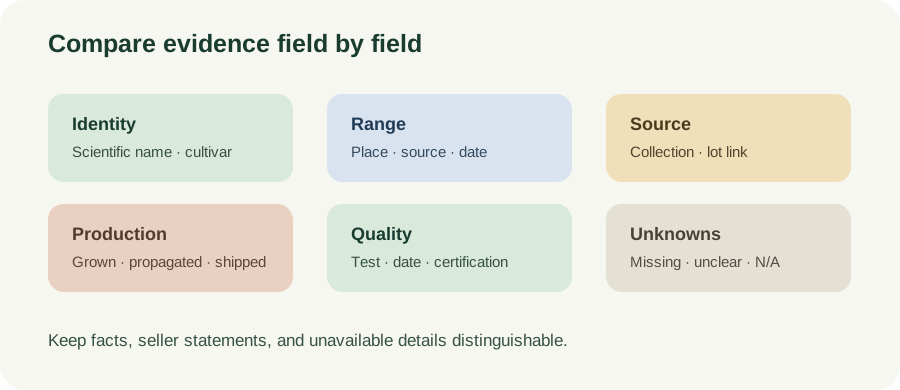
Record each offer separately
| Question | What to write down |
|---|---|
| What is it? | Scientific name, any cultivar or hybrid name, and the plant or seed form. |
| Where is it native? | The range source, its geographic scale, and the date or status wording it gives. |
| Where did this lot come from? | Collection or source area, if stated, plus the lot or accession identifier that ties the claim to the offer. |
| Where was it grown? | Production location and any propagation history the seller provides. Keep these separate from collection origin. |
| What else is documented? | Release or certification wording, seed-quality test and date, and any limits attached to those records. |
| What is unknown? | Missing, unclear, not applicable, or seller-described details that are not linked to a record. |
Ask neutral, specific questions: “Which place does this origin statement refer to?” “Is it linked to this lot?” “What does this certification name mean in its program?” A named location can describe a source without proving permission to collect, long-term sustainability, native status at your property, or garden performance. Quality tests answer quality questions; they do not establish provenance.
Label fields and disclosure rules can depend on the product and jurisdiction. Record the exact wording and check current rules for the item if the legal label requirement matters. Do not treat a missing optional detail as proof of a bad source, or a complete-looking label as proof that every claim is verified.
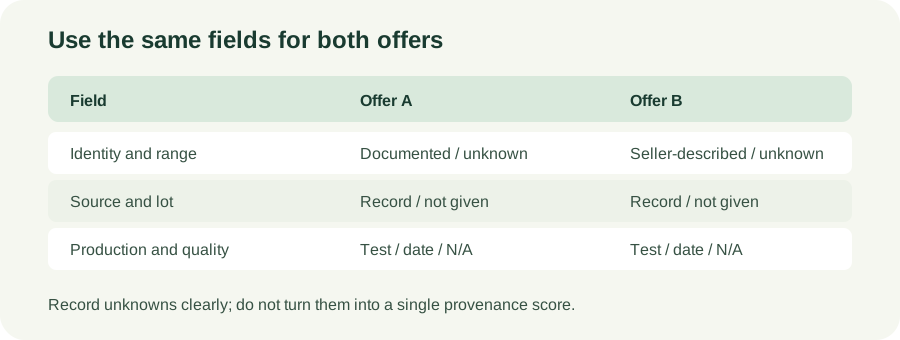
For help separating production from collection, read grown in versus collected from native material. For a shipment across the border, use the cross-border buying guide.
Sources and further reading
- How to buy a native plantauthoritative-secondary
- NTSC — Seed collection and conservationprimary
- National Tree Seed Centre codesprimary
- Plant Germplasm Development: A Guide for North American Native Plant Conservationprimary