Understanding NRCS Conservation Plant Release Classes
Decode the four NRCS Plant Materials Program release classes and find the release record without treating its class as proof of local fit.
On this page
An NRCS release class describes how a conservation plant material was identified or evaluated within the Plant Materials Program. Copy the full species and release name from the label before looking it up; similar words on a retail tag may belong to a different program.
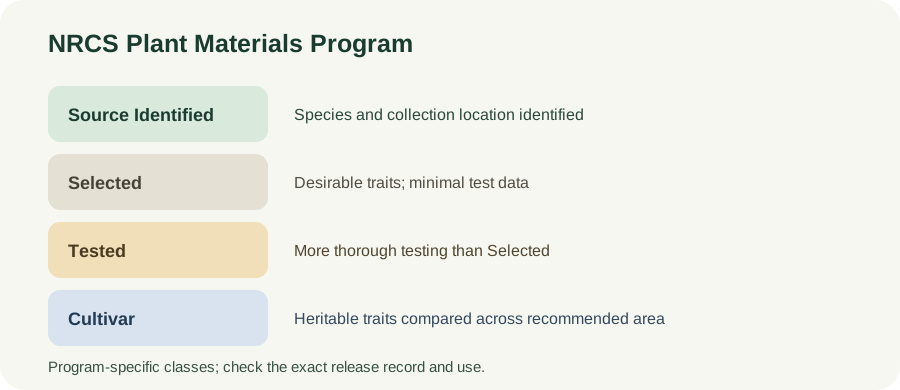
The four NRCS release types
| Release type | What NRCS says it communicates |
|---|---|
| Source Identified | An indigenous ecotype identified by species and collection location, without scientific evaluation. |
| Selected | Desirable traits shown in comparative evaluations, with minimal test data. |
| Tested | More thorough testing than a Selected release to evaluate whether desired traits are heritable. |
| Cultivar | Specific heritable traits judged superior through comparative trials across the recommended area. |
These descriptions are for NRCS Plant Materials Program releases. They do not form a universal scale for every certification, seller phrase, or Canadian forestry label. A class alone does not establish that a plant is native to your county, that this retail lot came from a particular source, that seed quality was tested, or that it fits your garden.
Look up the full release
Search the NRCS Conservation Plant Releases list by the release name or scientific name. Open the linked release notice or brochure when available, and check the stated conservation use and recommended area. Availability from a program is not the same as current nursery stock.
If the label instead says “local ecotype” or “source-identified” without naming NRCS, ask who defines the term and what lot record supports it. See Source-identified seed versus local ecotype for those seller-language questions.
Sources and further reading
- Plant Release Tips Pageprimary
- Conservation Plant Releasesprimary