Grown in versus collected from native material
Separate where seed or plant material originated from where it was propagated, grown, and shipped, and ask what the seller’s records actually describe.
On this page
“Grown locally” and “collected locally” describe different stages in a plant’s history. A growing location does not, by itself, identify where the original seed, cutting, or parent plant came from.
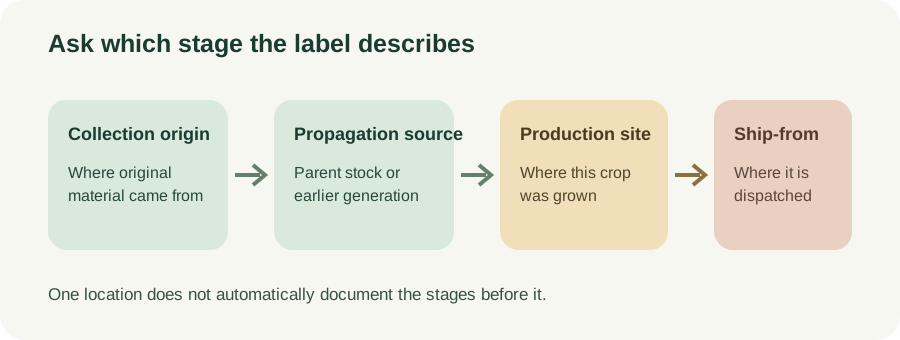
Four places to keep separate
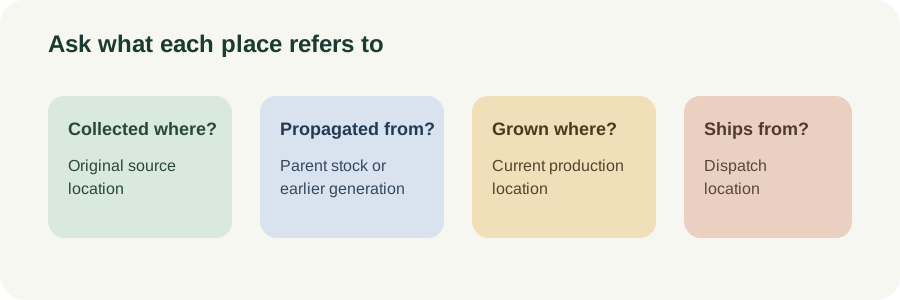
- Collection origin: where the original seed, cutting, or other material was collected.
- Propagation source: the parent stock or earlier generation used to produce this lot.
- Production location: where the current plants were grown or seed was increased.
- Shipping location: where the seller dispatches the order.
A label may identify one stage without documenting the others. A seed lot grown in a nearby field may have come from source material collected somewhere else. A shipping address is not a collection record. Ask which stage a phrase describes and whether the answer is tied to the specific lot.
Ask for the record behind the words
If the source matters to your project, ask for the species name, a source or collection region, a lot or accession identifier, and the production history the seller can document. Natural Resources Canada’s National Tree Seed Centre shows how a specialist collection can keep provenance, collection type, location, coordinates, elevation, and seed-test fields distinct. Those records are an example from a conservation collection system, not a universal nursery requirement.
Propagation history can matter, but a generation count is not a universal test of local identity or garden performance. Studies of Maximilian sunflower and one farmed Clarkia line found source or trait differences in their particular comparisons; neither study establishes how every species or retail lot behaves. Do not infer a local source, adaptation, or quality from “grown in” alone.
For a side-by-side way to record statements and unknowns, use the native plant provenance checklist.
Sources and further reading
- NTSC — Seed collection and conservationprimary
- Testing for evolutionary change in restoration: a genomic comparison between ex situ, native, and commercial seed sources of Helianthus maximilianiprimary
- Eight generations of native seed cultivation reduces plant fitness relative to the wild progenitor populationprimary