Buying Plants and Seeds Across the U.S.–Canada Border
Prepare the exact plant or seed details, check current import and destination rules, and identify when a separate CITES permit review may apply.
On this page
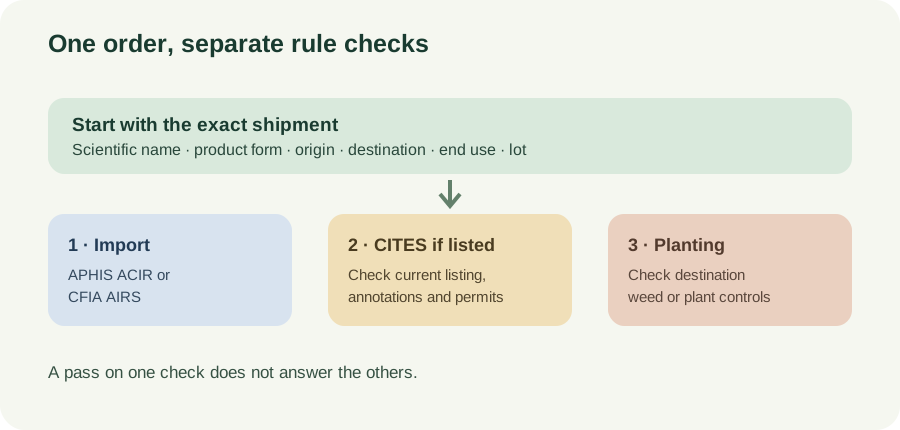
For a cross-border order, identify the exact item before relying on a seller’s shipping statement. Plant-health admissibility, CITES trade controls, and permission to plant at the destination are separate checks.
Gather the shipment details
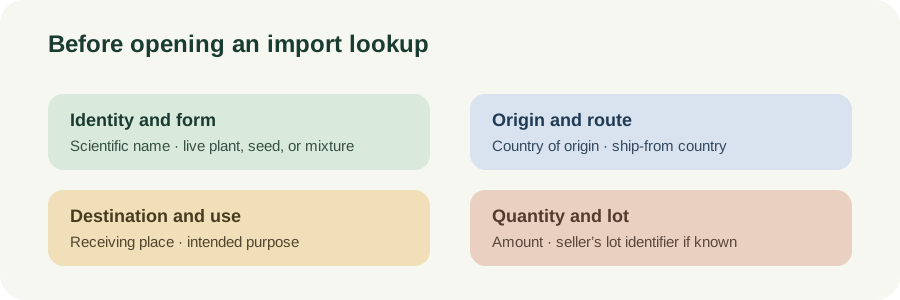
Write down the scientific name, live plant or seed form, every named seed-mixture component, country of origin, ship-from country, destination, intended use, quantity, and lot information if available. If you are buying seed, note whether it is represented for propagation. In Canada, CFIA guidance includes propagation seed attached to materials such as seed tapes, mats, and lawn-patch mixes, as well as pet-grazing pots and microgreen seed. Identify the actual species or crop kind; a marketing name such as “catgrass” is not a species name.
Check the import pathway
For a U.S. destination, search the current APHIS ACIR requirements using the commodity and country of origin. Follow the listed permit or agency route for that exact item. For a Canadian destination, search CFIA’s AIRS by commodity, origin, destination, and end use. AIRS is a reference tool; check the governing requirements and follow CFIA instructions for the shipment.
Check other controls separately
If the scientific name is covered by CITES, use the current CITES species checklist and read the listing’s appendix and annotations. Required permits depend on the listing, specimen form, purpose, and route, and may need to be obtained before trade. Follow the current U.S. Fish and Wildlife CITES guidance or Canadian permit guidance. A CITES check does not replace APHIS or CFIA plant-health requirements.
Then check whether the species or any mixture component may be planted at the destination. In the United States, APHIS links federal noxious-weed information and directs users to state authorities for state-regulated weeds. In Canada, check current federal, provincial or territorial, and municipal controls that apply to the place. If a result is unclear, ask the responsible agency before ordering. None of these checks establishes that the plant is native or a good fit for the site.
Sources and further reading
- How To Import Plants and Plant Products into the United Statesprimary
- Agricultural Commodity Import Requirements (ACIR)primary
- Automated Import Reference System (AIRS)primary
- ABCs of seed importation into Canadaprimary
- CITES Appendicesprimary
- The CITES species checklistprimary
- Permits for trade in protected speciesprimary
- Federal Noxious Weedsprimary