Troubleshooting & Site Diagnostics
Streambank erosion in Pennsylvania: when planting may not be enough
Document Pennsylvania streambank change safely and learn when planting questions need local watershed or restoration review.
On this page
Plants can support a stream buffer, but planting alone does not establish why a bank is changing or whether it is stable. Streams move water and sediment naturally. This guide is for observation and escalation, not repair design.
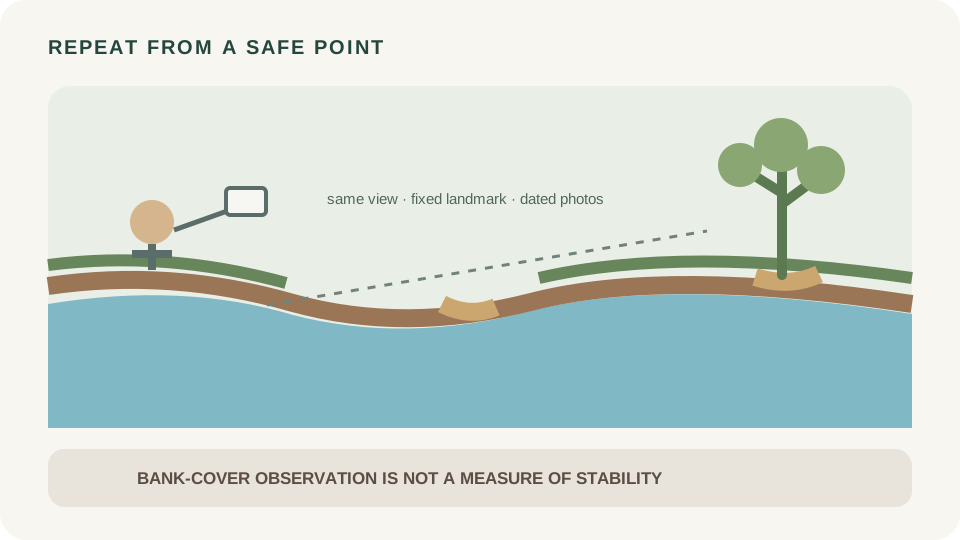
Make a repeatable record from a safe place
Choose a stable point well back from the edge. Photograph the same reach with a fixed landmark. Note date, recent storms, changed soil or vegetation, exposed roots, sediment, and nearby drainage or construction. Do not enter fast or deep water or approach an unstable edge.
Penn State distinguishes natural erosion and deposition from excessive erosion affecting property, habitat, or water quality. Vegetation may take years to stabilize a bank, and erosion can continue. FISH can help repeat observations of vegetation cover, but its score does not measure stability or diagnose cause.
When planting needs broader review
Ask whether change is rapid, the bank undercut or slumping, or infrastructure at risk. Identify the owner and whether a county conservation district, municipality, watershed group, or stream professional should be involved. Planting cannot be assumed to correct concentrated runoff or altered flow.
Before earthwork, channel changes, or planting near water, contact the landowner and local authority. Requirements depend on site and proposed work; this page does not establish permission.
Save dated images and notes instead of labeling the bank from appearance alone. Prepare a concise site record. If erosion is rapid, the bank visibly unstable, or infrastructure at risk, keep away and seek prompt local guidance.
Sources and further reading
- Backyard Stream Repair FAQsauthoritative-secondary
- FISH: First Investigation of Stream Healthauthoritative-secondary