Troubleshooting & Site Diagnostics
Standing water in an Ontario rain garden: observe, adjust, or redesign
Interpret ponding in an Ontario rain garden in light of its installed design, visible flow paths, and maintenance responsibility.
On this page
Some rain gardens hold runoff temporarily. Ponding depends on the installed practice: infiltration, filtration, a liner, or an underdrain can behave differently. One view cannot establish failure or need for repair.
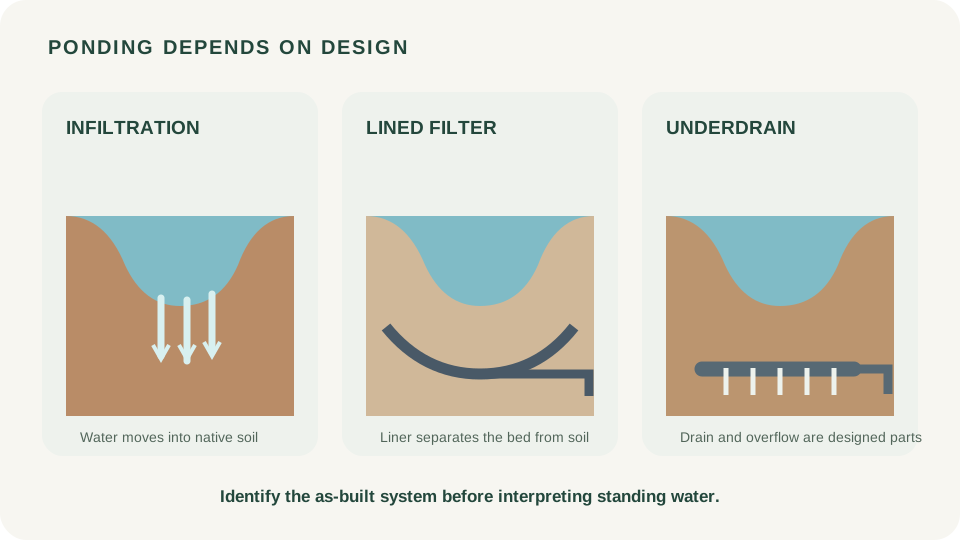
Make a safe, repeatable observation
From a stable, dry edge, note the date, rainfall, water location, approximate depth, and duration. Repeat after another storm. Note visible inlet or overflow obstruction, debris, sediment, erosion, or plant dieback. Do not enter deep, fast-moving, contaminated, or unstable water, remove components, or dig for a drain.
Find the design or maintenance plan and identify who owns the feature. An underdrain, liner, overflow, or engineered media cannot be evaluated from surface appearance alone.
Keep thresholds in their design context
Ontario’s stormwater manual gives inspection guidance for particular practices. It uses ponding beyond 24 hours as a signal for certain practices; for infiltration basins, more than one-third of design ponding depth remaining after 48 hours is also an inspection trigger. These practice-specific signals are not universal home rain-garden cutoffs. Compare them with the as-built design and maintenance plan.
When to contact the responsible professional
Contact the installer, owner/operator, municipality, or qualified stormwater professional if ponding exceeds design expectations, an inlet or outlet is damaged, erosion increases, water threatens a building, or you are considering site changes. Escalate possible contaminated runoff. Do not redirect water to another property or make an engineered change based on a generic diagram. For a plant-health concern, record the symptoms and site history.