Native Plants for Sites Near Road Salt in Illinois
Compare Illinois native plants listed for salt tolerance by light, moisture, mature size, and the limits of each source's rating.
On this page
Illinois Extension and the Northeastern Illinois native tree and shrub list identify candidates described as salt tolerant. Those labels are useful for making a first shortlist, but neither source gives a salt dose, exposure duration, or a reliable way to rank performance at a particular roadside. Check whether a planting will receive spray, salty runoff, or salt in the root zone, then compare each candidate’s other site needs.
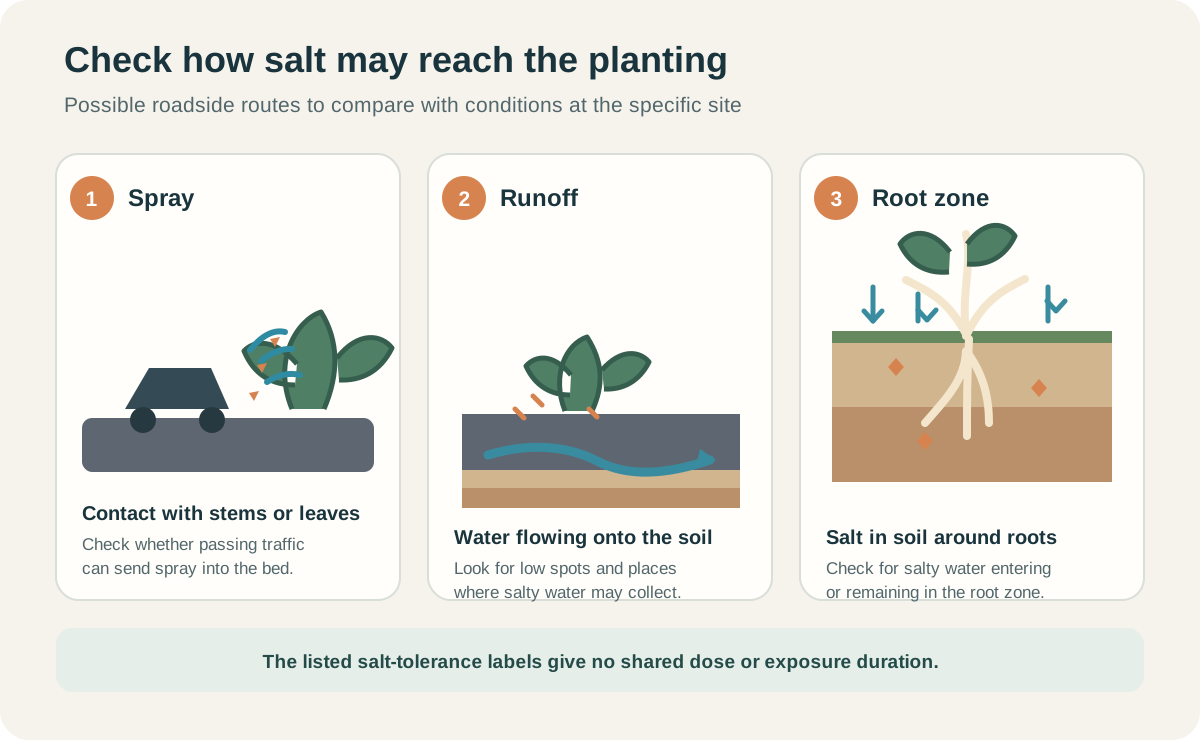
Check for spray, runoff, and root-zone exposure at the site. Neither source provides a shared salt dose or exposure duration.
Perennials and grasses
| Candidate | Source-listed site fields | What the listing establishes |
|---|---|---|
| Eastern prickly pear (Opuntia humifusa) | 6 inches; dry; full sun or part shade | Illinois Extension lists it among moderate-to-high salt-tolerance plants. Its small stature and dry-site fit are separate from the unquantified salt rating. |
| Lanceleaf coreopsis (Coreopsis lanceolata) | 1–2 feet; medium to dry; full sun | The source includes it in the salt-tolerant selection. “Medium” soil may be briefly damp before drying; the listing does not describe a salt threshold. |
| Nodding wild onion (Allium cernuum) | 1–2 feet; dry; full sun or part shade | A listed candidate for dry conditions. Confirm local range and whether its light and moisture fit the planting strip. |
| Purple lovegrass (Eragrostis spectabilis) | About 2 feet; dry; full sun or part shade | The source identifies a salt-tolerance category and a dry-site profile, without a measured exposure limit. |
| Dwarf blue indigo (Baptisia australis var. minor) | About 3 feet; medium to dry; full sun | Consider the listed height and open-sun requirement along with the qualitative salt label. |
| Foxglove beardtongue (Penstemon digitalis) | About 4 feet; medium; full sun or part shade | The source lists it as salt tolerant and gives a medium-moisture site category; it does not specify which salt exposure it can withstand. |
| Shrubby St. John’s wort (Hypericum prolificum) | About 5 feet; medium to dry; full sun | This is the largest of the listed perennial-type candidates here. Check space and soil moisture as well as the salt label. |
Northeastern Illinois shrubs
The regional tree and shrub list marks the following native shrubs “road salt tolerant.” The label is not accompanied by an exposure threshold. The listed dimensions and forms can still help rule out candidates that do not fit the available space.
| Candidate | Source-listed site and mature form |
|---|---|
| Common ninebark (Physocarpus opulifolius) | Wet to medium soil; full sun to part shade; 6–10 feet tall and wide. |
| Fragrant sumac (Rhus aromatica) | Dry, well-drained soil; full sun to part shade; 2–5 feet tall and 5–10 feet wide; thicket-forming. |
| Shining sumac (Rhus copallina) | Dry, well-drained soil; full sun to part shade; 20–35 feet tall and wide in the source; thicket-forming. Retain the unusually large dimensions as listed and verify the intended plant form locally. |
| Smooth sumac (Rhus glabra) | Dry soil; full sun; 10–15 feet tall and wide; thicket-forming. |
| Wild gooseberry (Ribes missouriense) | Medium to dry soil; full sun to part shade; 3–4 feet tall and 3–5 feet wide; thicket-forming. |
| Scarlet rose (Rosa palustris) | Wet soil; part shade; 3–6 feet tall and wide. |
| Prairie willow (Salix humilis) | Medium soil; part shade; 4–10 feet tall and 6–12 feet wide; thicket-forming. |
| Meadowsweet (Spiraea alba) | Wet soil; full sun; 3–6 feet tall and 2–3 feet wide. |
| American cranberry (Viburnum opulus var. americanum, listed as V. trilobum in the source) | Wet to medium soil; full sun to part shade; 8–12 feet tall and wide; the source also notes flood and road-salt tolerance. |
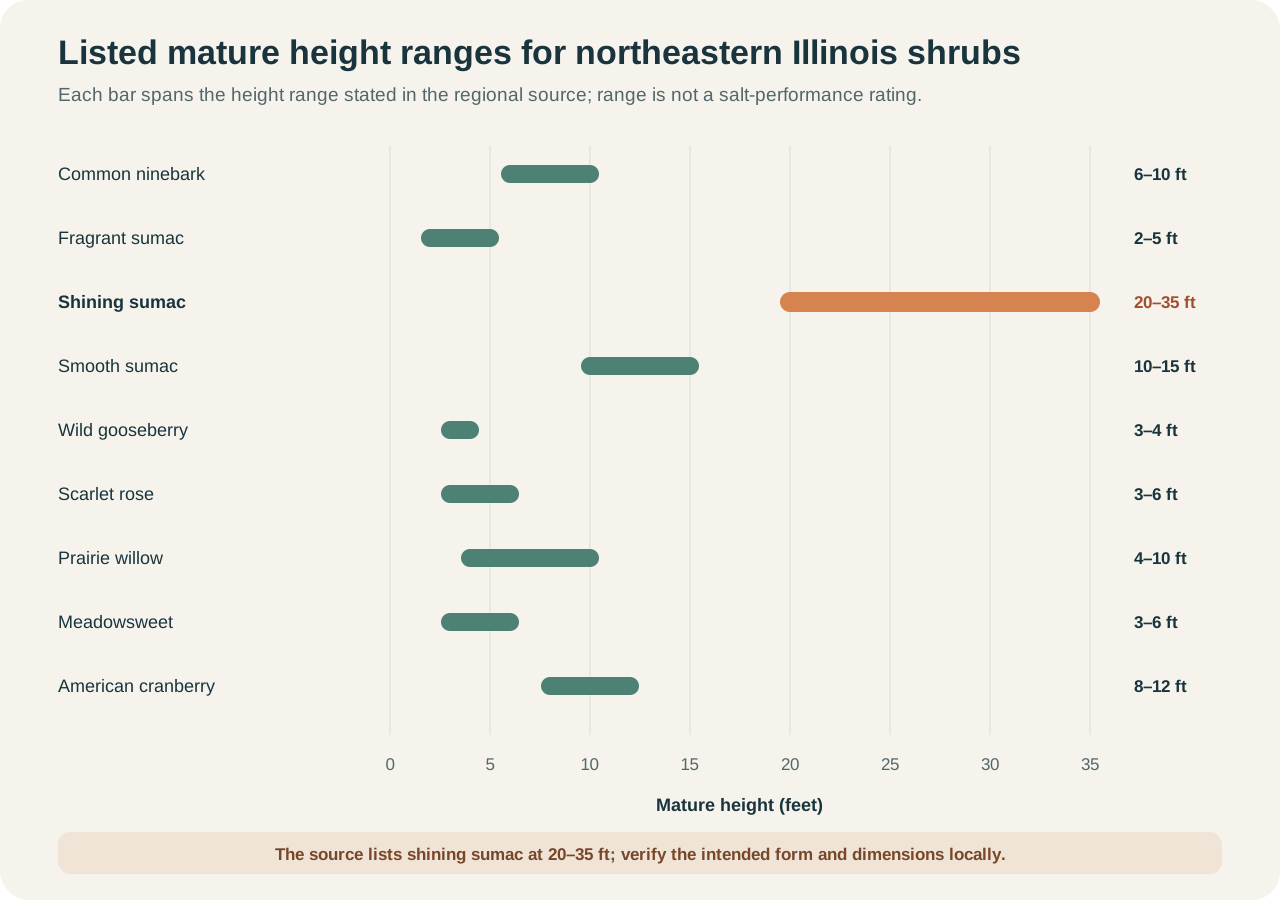
Height ranges are copied from the regional list; its 20–35-foot shining sumac entry is retained as published and warrants local verification.
Use the list as a screen
In the Illinois Extension guide, “medium” means soil that is damp briefly and then dries; “dry” means sandy or usually dry soil. Those moisture labels help narrow the site fit but do not change the uncertainty around salt exposure.
The two lists do not establish county-level native occurrence, nursery provenance, or performance under a specific road’s maintenance practices. They also use different candidate sets and do not provide a shared salt scale. Before planting, verify local range and stock identity, measure the available mature space, and observe how wet the site stays. Treat a salt-tolerant label as one attribute to investigate, not a promise that a plant will thrive in every salty roadside condition.
Sources and further reading
- Salt-Tolerant Nativesauthoritative-secondary
- Trees & Shrubs Native to Northeastern Illinoisauthoritative-secondary