Maryland Native Groundcovers by Site
Compare Maryland Extension groundcover examples by light, moisture, browse notes, seasonality, and their different ways of spreading.
University of Maryland Extension presents groundcovers as a varied group rather than a single fix for bare soil. Its table is a sample, not a complete native-plant list. Check the regional range for a Maryland location and compare the planting site’s light and moisture before using any entry. The source also cautions that deer response is uncertain and varies.
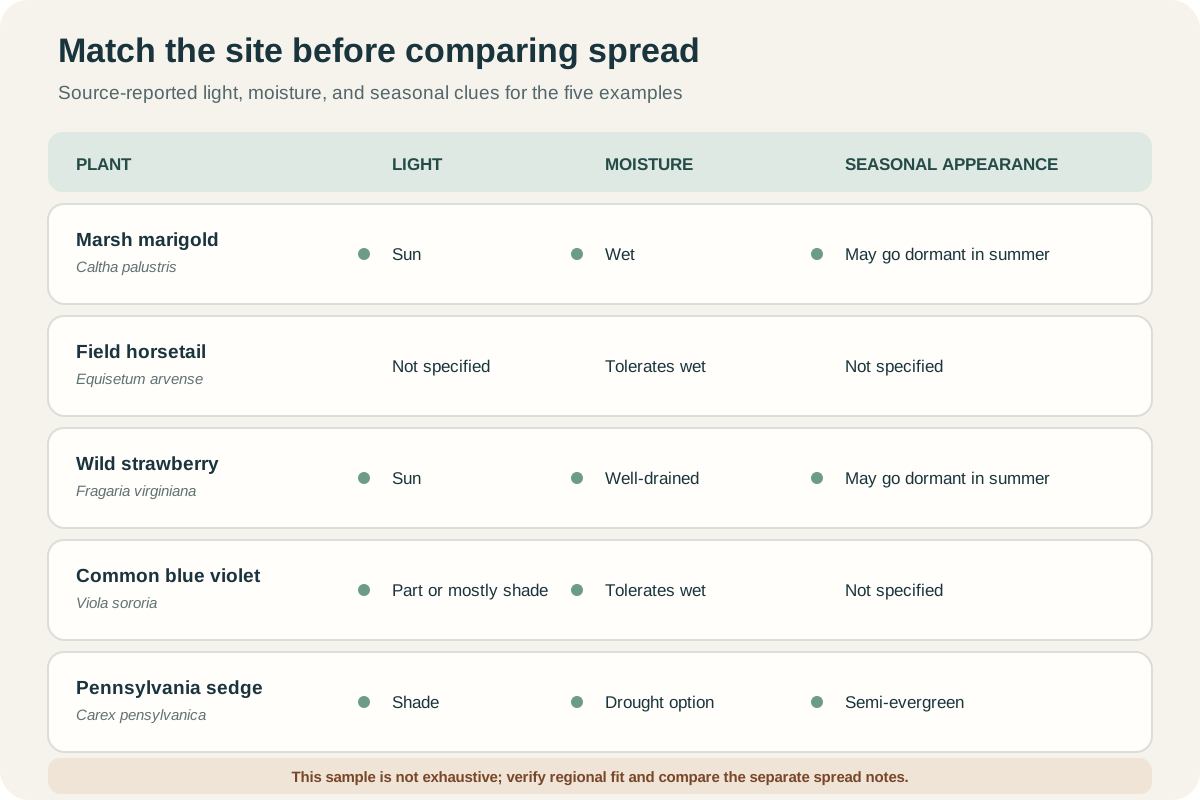
The display repeats the table’s site and seasonal clues; it does not establish county-level range or guaranteed coverage.
| Candidate | Site and seasonal clues | Spread and browse notes |
|---|---|---|
| Marsh marigold (Caltha palustris) | Suits sunny, wet locations. It may go dormant in summer heat or drought. | The table records low browse pressure and notes rhizomes and self-seeding. Dormancy can leave a seasonal gap. |
| Field horsetail (Equisetum arvense) | Tolerates wet conditions and has deep roots. | Low browse is recorded, but the plant spreads by aggressive rhizomes. Its spread habit makes it a poor choice where it cannot be contained. |
| Wild strawberry (Fragaria virginiana) | Suits sun and well-drained soil; may become dormant in summer. | Runners create a spreading patch. The table records average browse pressure, not immunity. |
| Common blue violet (Viola sororia) | Tolerates wet conditions and is suited to part shade or mostly shade. | Rhizomes and self-seeding can produce an aggressive colony; the table records average browse pressure. Leave space for spread. |
| Pennsylvania sedge (Carex pensylvanica) | A shade and drought option in the table; it remains semi-evergreen. | It spreads slowly by rhizomes, and the table records low browse pressure. Slow spread means it may take time to fill an area. |
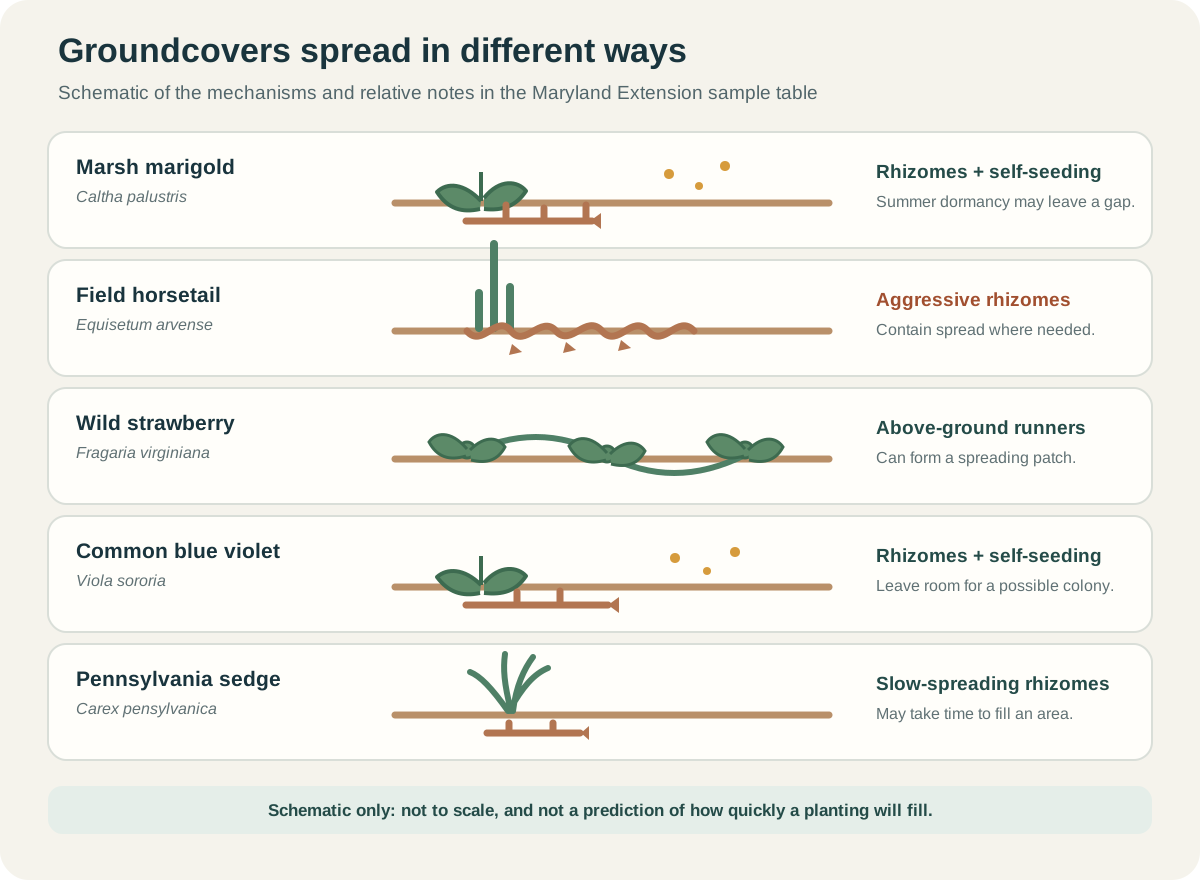
Schematic of the spread mechanisms in the table; the drawings are not to scale or a prediction of how quickly coverage will develop.
The browse labels are relative source notes, not a guarantee that deer will leave a planting alone. Establishment and seasonal appearance also differ: a wet-site plant that disappears in summer, a fast rhizomatous spreader, and a slow semi-evergreen sedge create different maintenance needs. If the site combines several constraints, compare them separately and leave room for spread rather than treating “groundcover” as a promise of uniform cover.
Sources and further reading
- Groundcoversauthoritative-secondary