Common Hackberry Profile for Minnesota
A Minnesota profile of common hackberry covering regional range, broad soil and moisture tolerance, urban stress notes, large size, and wildlife use.
Common hackberry (Celtis occidentalis) is native to Minnesota. University of Minnesota Extension notes that it occurs commonly in southern and central Minnesota, including river terraces and floodplains. Check the local range and planting stock for the specific site rather than treating the state-level profile as proof of county occurrence.
Site profile
| Field | Source description |
|---|---|
| Mature size | About 50–70 feet tall and up to 50 feet wide. |
| Light | Full sun to part shade. |
| Soil and drainage | Clay through sandy soils; dry to wet conditions; well-drained or poorly drained soil. |
| Urban stresses | Tolerates heat, drought, salt spray, wind, ice, and short-term flooding. The source does not give a salt dose or flood-duration threshold. |
| Wildlife and appearance | Fruits feed birds and small mammals. Witches’ brooms are described as cosmetic. |
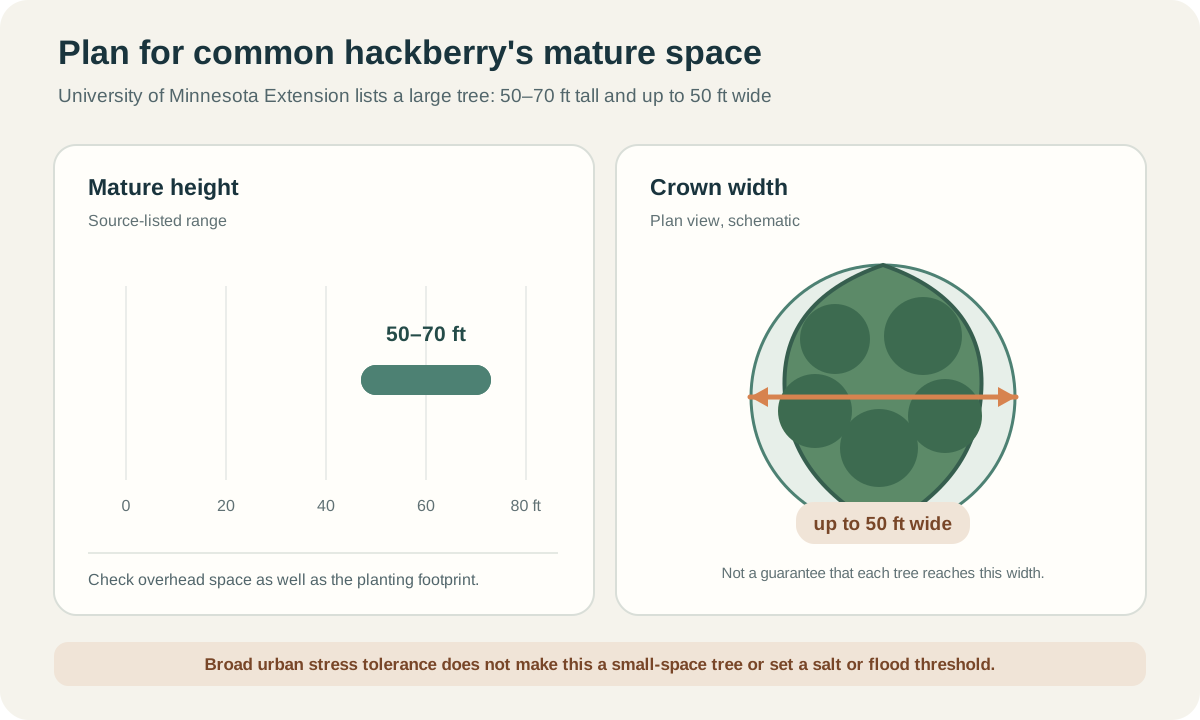
Use the listed size as a space screen; the source’s salt-spray and short-term-flood notes have no dose or duration threshold.
Hackberry’s broad stress tolerance does not make it a small-space tree or establish performance under continuous flooding or a particular deicing regime. Compare the mature crown with overhead and nearby space, then verify local range, site drainage, and the exposure the tree will actually receive.
Sources and further reading
- Common hackberryauthoritative-secondary