Plant Communities & Habitat Design
Pennsylvania residential hedgerow: a phased case study
A Pennsylvania homeowner's reported hedgerow case shows phased planting around drainage, privacy, and a changing property edge.
On this page
A hedgerow can combine a boundary, habitat, and site-specific planting roles, but one homeowner’s project is an example rather than a tested recipe. Penn State Extension describes three areas added over time in Lancaster County, each responding to a different yard condition. The account is useful for seeing how a layered planting can evolve; it does not establish that the same plants or layout will work elsewhere.
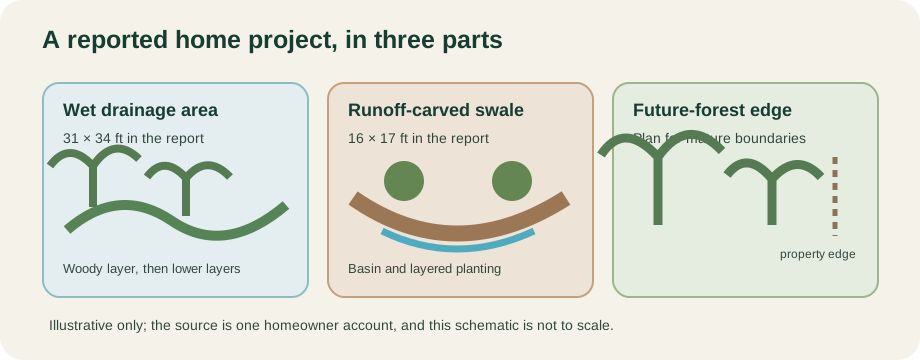
Three areas, three decisions
In the first area, a 31-by-34-foot drainage problem led the homeowner to begin with moisture-tolerant trees and shrubs, then add perennials and groundcovers. In a separate 16-by-17-foot swale shaped by runoff from a neighbor’s property, the homeowner created a water-catching basin and used red-twig dogwoods with perennials. A third area was planned as a future forest edge, with mature plant size considered against the property boundary.
These details belong to that account. It reports wildlife visits but gives no measured before-and-after runoff result, establishment rate, cost, or controlled comparison. The listed plants are not a Pennsylvania-wide hedgerow palette, and the story does not prove that a planting will solve drainage at another property.
What to take from the case
Start by identifying what each part of the property needs to do. Keep wet and drier sections distinct, choose layers that fit their space, and plan for mature dimensions and access. If a project changes how water flows, confirm local requirements and a safe overflow path before digging. Build in phases that leave room to observe how the site responds and adjust later choices.
Use the case as a prompt for questions, not a template. Verify each plant’s local native range, site fit, size, and source. For a broader method, see how to adapt a native plant community to your yard.
Sources and further reading
- Hedgerows for the Home Gardenauthoritative-secondary