Small-Lot Native Privacy Screen for Dry Soil in Virginia
Plan a Virginia privacy screen around the views you want to block, regional native range, mature size, utilities, and dry-site conditions.
On this page
A privacy screen should block the view that matters without taking space the lot does not have. Before choosing plants, mark the sightline, the seasons when screening is needed, the dry areas, and the room available for mature growth. A Virginia-wide species list cannot replace the site’s physiographic region and local checks.
Measure the view and the planting space
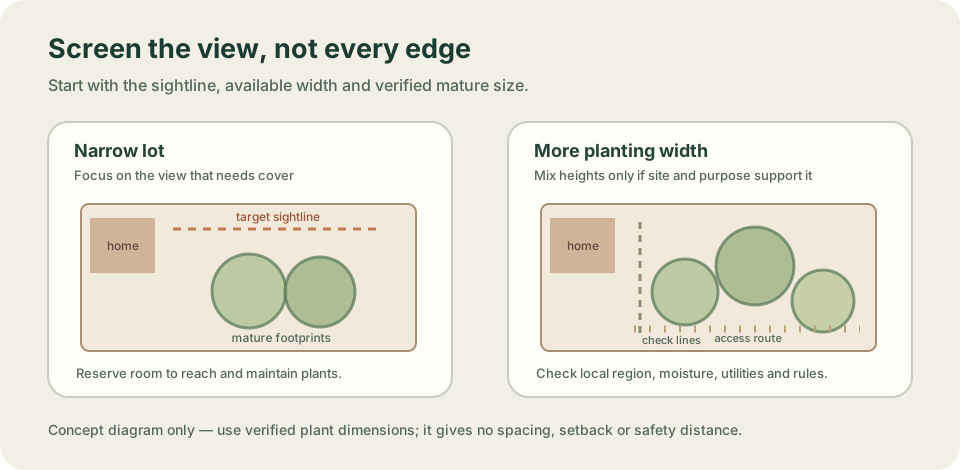
Mark the window, patio, or boundary view you want to soften and decide whether leaves must block it year-round. An evergreen screen and a deciduous planting provide different seasonal cover. On a narrow lot, a few well-placed plants at mature size may solve the view better than a continuous row. Leave room to reach the screen and avoid blocking doors, paths, or sightlines needed for safe access.
Check the site’s moisture over time. “Dry soil” might reflect a slope, shallow soil, a roof overhang, or a dry spell; those situations do not all call for the same plants. Compare light, moisture, mature height and spread, growth habit, and the water you can provide while plants establish.
Use the Virginia region before choosing candidates
Virginia DCR publishes separate native-plant guides for the Piedmont, Coastal Plain, and Mountain regions. Match the property to the right guide, then use its light, moisture, and intended-use fields to narrow candidates. Check the exact plant’s local native range, mature dimensions, spreading behavior, and suitability for a privacy function. The regional tables are lookup aids, not complete screen designs.
Virginia Cooperative Extension describes the spacing trade-off for shrub borders: closer spacing can fill sooner but uses more plants, while wider spacing takes longer. Base the layout on verified mature width and your preferred fill time; do not treat any example distance as a statewide rule. Consider a small grouped screen, mixed heights, or a limited screen at the key view instead of a single tight row.
Check utilities and local constraints before digging
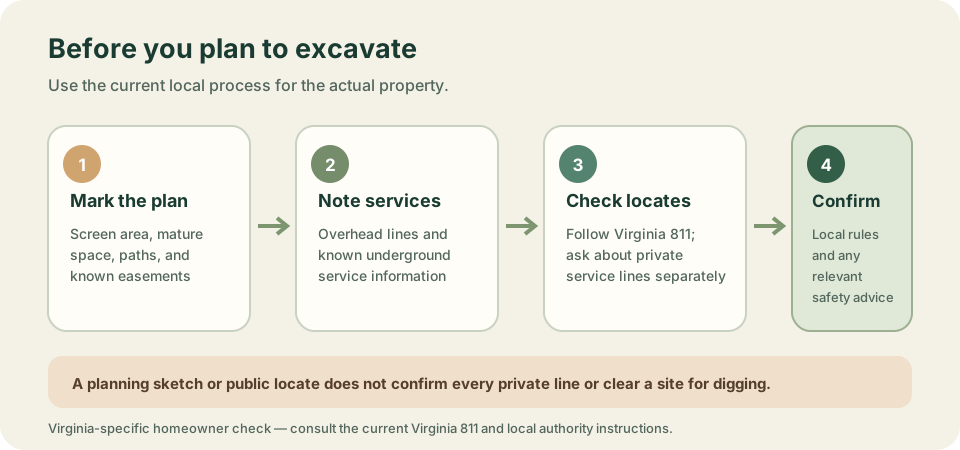
Mark overhead lines, easements, paths, and known buried services on the site plan. Before excavation, follow the current Virginia 811 process and separately check for privately owned lines that a public locate request may not mark. Verify local rules and access requirements for the actual property. If wildfire exposure or another safety concern affects the lot, use current local authority guidance rather than a general plant list or universal setback.
Use the site-plan guide to map fixed features and the Virginia 811 homeowner information before planning excavation. Confirm candidate availability and source identity with a nursery; a plant being native somewhere in Virginia does not mean it is local to every Virginia property.
Sources and further reading
- Problem-free Shrubs for Virginia Landscapesauthoritative-secondary
- Selecting and Managing Trees to Avoid Conflicts with Overhead Utility Linesauthoritative-secondary
- What to Expectprimary
- Native Plants for Conservation, Restoration and Landscaping — Piedmont Regionauthoritative-secondary
- Native Plants for Conservation, Restoration and Landscaping — Coastal Plain Regionauthoritative-secondary
- Native Plants for Conservation, Restoration and Landscaping — Mountain Regionauthoritative-secondary