How to Plan a Native Planting on Clay Soil in Michigan
Assess a Michigan clay site, compare local native plants by soil and water conditions, and plan installation without treating clay as one uniform problem.
On this page
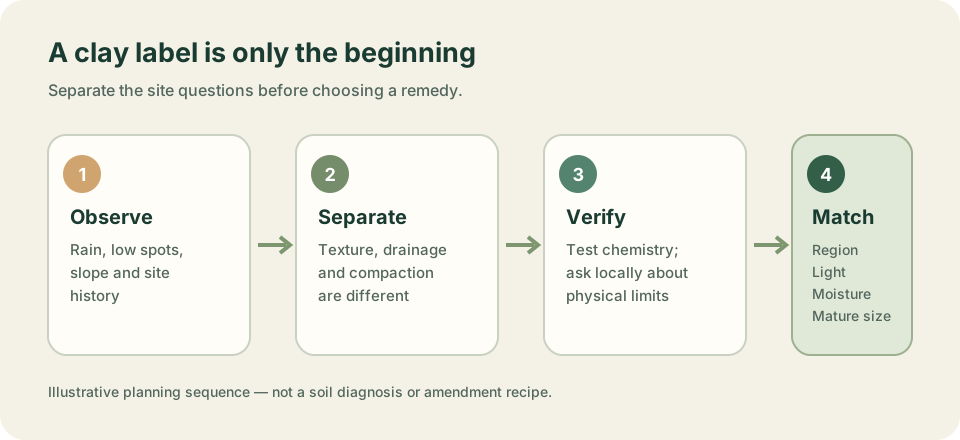
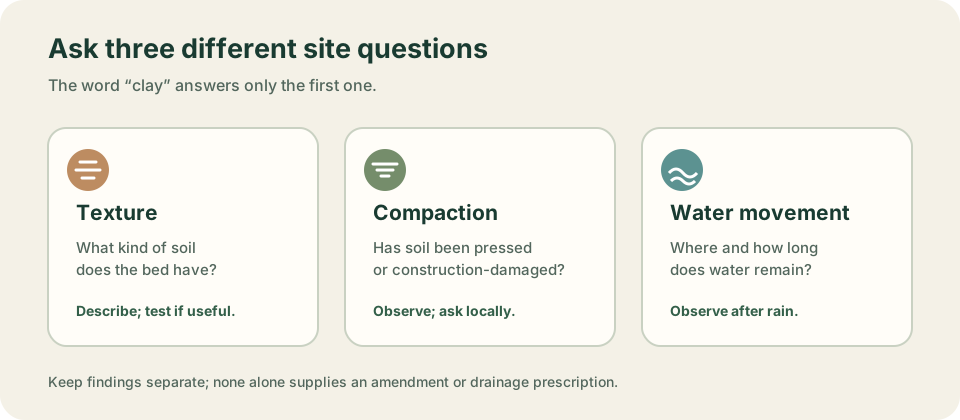
Clay describes soil texture; it does not tell you by itself how a particular bed drains, whether it has been compacted, or which plants will fit. A Michigan planting plan starts by separating those questions, then matching each planting area to locally native candidates and the way water moves there.
Describe the site before changing the soil
Draw the area and note low spots, slopes, downspouts, shade, and where water remains after rain or snowmelt. Record construction history if the site was recently graded or filled. Clay can hold water and nutrients, while compaction can restrict air, water, and root movement; those conditions need different responses. A soil-fertility test can help with pH and nutrient questions, but it does not diagnose compaction or drainage.
For a test, use Michigan State University Extension’s current soil-testing service and follow its sample instructions. MSU also publishes separate native-plant resources for Michigan’s southern Lower Peninsula, northern Lower Peninsula, and Upper Peninsula. Start with the list for your region, then compare each candidate’s light, moisture, and mature size with the actual bed. A statewide native label or a hardiness zone alone does not establish that a plant fits this clay site.
Plan around mature plants and the site’s water pattern
Map the planting at mature dimensions and leave a route for watering, weeding, and inspection. If one part stays wet while another dries quickly, keep those areas distinct rather than using a single “clay” label for the whole bed. If the location is persistently saturated, has a shallow restrictive layer, or receives concentrated runoff, pause before grading or adding drainage; get local site-specific advice.
Prepare individual planting spots carefully
For woody plants, follow instructions for the species and stock you bought. Penn State Extension’s tree-planting guidance says that hard-to-dig, clumped soil may call for a wider planting hole, and that sticky clay can glaze the sides; roughening those sides helps avoid a smooth barrier. The same guide advises setting the plant no deeper than its root system and using the excavated soil as backfill in most cases. These are source-specific tree and shrub instructions, not a universal formula for every perennial or every clay site.
Do not add sand, fertilizer, or organic matter across a whole bed just because the soil is clay. Use test results and local recommendations for any amendment, and keep drainage, soil chemistry, and physical compaction as separate decisions. For the larger property map, see the native-garden site-plan guide; for runoff projects, use the rain-garden planning guide.
Sources and further reading
- Smart Gardening: Using Native Plants Is a Smart Choice for Michigan Landscapesauthoritative-secondary
- Michigan State University Soil Testauthoritative-secondary
- Plant With Careauthoritative-secondary
- Understanding Tree Planting in Construction-Damaged Soilsauthoritative-secondary