How to read affiliate and sponsored native-plant recommendations
Recognize commercial relationships in plant recommendations and assess disclosure separately from ecological evidence and site fit.
On this page
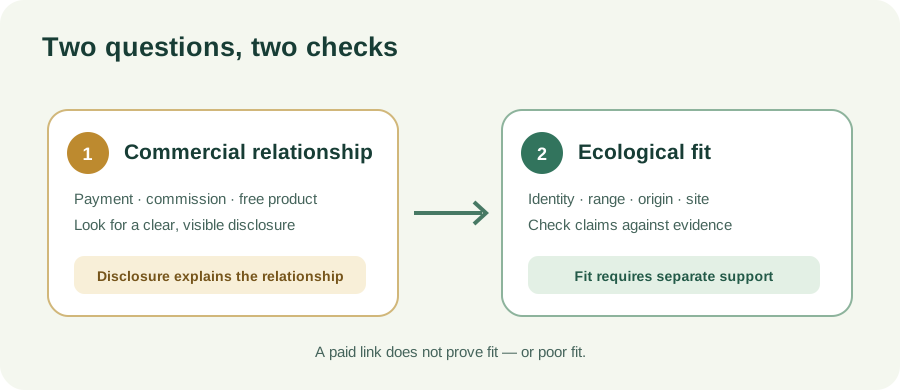
A useful plant recommendation answers two different questions: whether a commercial relationship affected the placement, and whether the plant fits the reader’s region and site. A disclosure helps readers understand the first question; it does not answer the second.
Look for a clear relationship statement
Payment, sales commissions, free products, discounts, or another material connection can affect how a reader weighs a recommendation. The U.S. Federal Trade Commission says disclosures should be clear and conspicuous. Canada’s Competition Bureau recommends prominent, plain-language disclosures and says an affiliate link, brand tag, or discount code alone is unlikely to explain the connection.
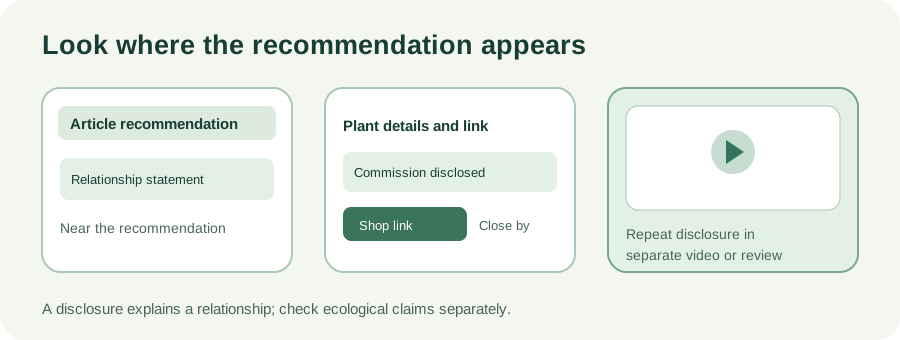
Look beside the recommendation or purchase link for a direct explanation such as “We may earn a commission if you buy through this link.” If a review, video, or comparison is separated from its links, check whether the disclosure remains visible in both places. Paid articles or placements should be identifiable as advertising rather than presented as independent editorial review. These are general guides, not a ruling on any particular publisher or arrangement.
Evaluate the plant claim on its own
After noting the commercial connection, check the scientific name, native-range evidence, source or lot information, site requirements, and the basis for any wildlife or performance claim. Ask how suppliers were selected and whether paid placement affects order or prominence. A clear disclosure does not make an unsupported ecological claim reliable, and an affiliate relationship alone does not show that a plant is a poor choice.
Compare those details with the buyer checklist and the regional guides. If an article does not disclose how it earns money, treat that as a transparency gap; use independent regional and plant-level sources before buying.