Winter care for newly planted trees and shrubs after a dry fall
Check root-zone moisture, mulch placement, exposure, and freeze-thaw signs before choosing locally appropriate winter care.
On this page
A recent transplant may enter winter with a small root system, but a dry autumn does not automatically mean it needs water. Check the root zone, drainage, exposure, and local forecast before choosing a step. A hardiness zone alone does not determine winter protection.
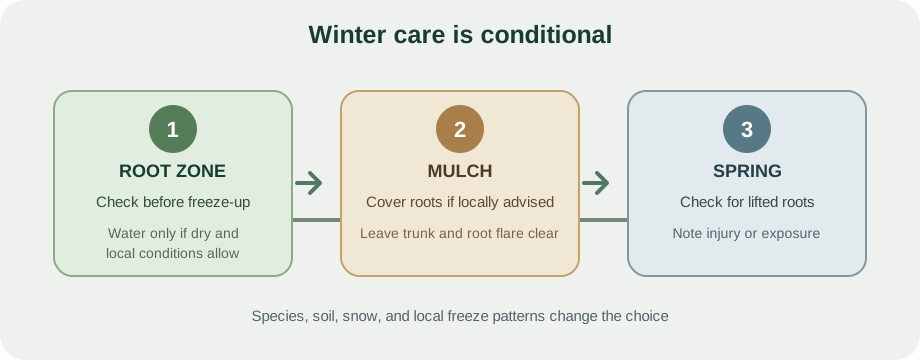
Check moisture while the ground is workable
Check below the surface near the root ball and compare it with nearby soil. If both are dry and the ground is not frozen, follow local extension guidance for watering before freeze-up. Do not water frozen ground or keep a poorly drained root zone saturated. Rainfall, soil texture, snow cover, plant size, and the timing of freezes all affect what the check means.
Illinois and Minnesota Extension sources describe regional examples of late-season watering and root protection. Their dates, quantities, and mulch depths are not a single schedule for Ontario, Virginia, or every U.S. location. If soil remains wet or water repeatedly pools, investigate drainage rather than adding more water.
Protect roots without covering the trunk
Where local guidance supports it, an insulating mulch layer over the root zone may reduce rapid soil temperature swings. Keep the trunk and root flare visible; mulch piled against bark can trap moisture and hide damage. There is no universal depth or material for every site. Check after windy weather that mulch has not shifted over the crown or been washed into a drain.
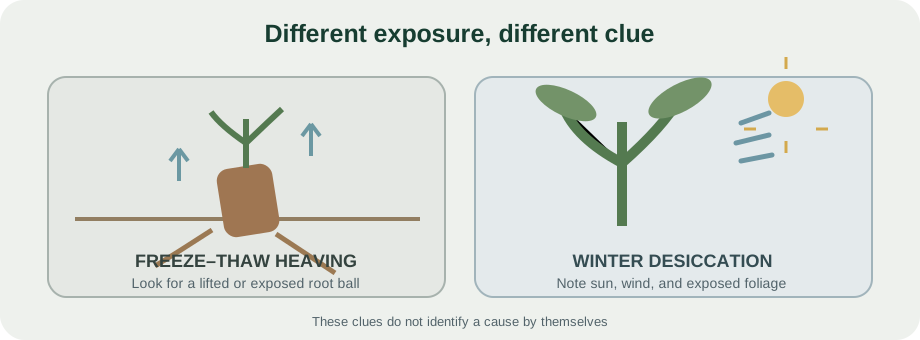
Evergreens on exposed sites can lose moisture during winter wind and sun, while repeated freezing and thawing can heave shallow-rooted plants. These are different stresses and may need different local responses. A barrier or wrap is not automatically helpful; consult plant-specific guidance before installing one. If browsing is evident, choose a guard only when local advice and the plant’s size support it.
Recheck in spring
Look for a lifted root ball, exposed roots, bark injury, broken branches, or a plant that has shifted. Photograph changes and restore soil or mulch only where appropriate; do not bury a trunk or force a heaved plant back without checking the roots. For recurring damage, ask a local extension office, nursery professional, or arborist to assess the plant and site. For growing-season watering checks, see the Virginia dry-shade guide; it does not establish a winter schedule.
Sources and further reading
- Winter protection for woody plantsauthoritative-secondary
- Protecting trees and shrubs in winterauthoritative-secondary
- Winter Injury Observed in Ornamental Plantingsauthoritative-secondary