Caring for a native garden in a wildfire-prone landscape
Maintain plant health and reduce connected dry fuels while following current, property-specific fire-safety guidance.
On this page
Native plants are not automatically fire-resistant, and no plant is fireproof. In a wildfire-prone area, garden care should follow current local fire-authority guidance while accounting for plant condition, dry material, and how vegetation connects across the property. A regional firewise guide cannot set your home’s clearance distances or plant list.
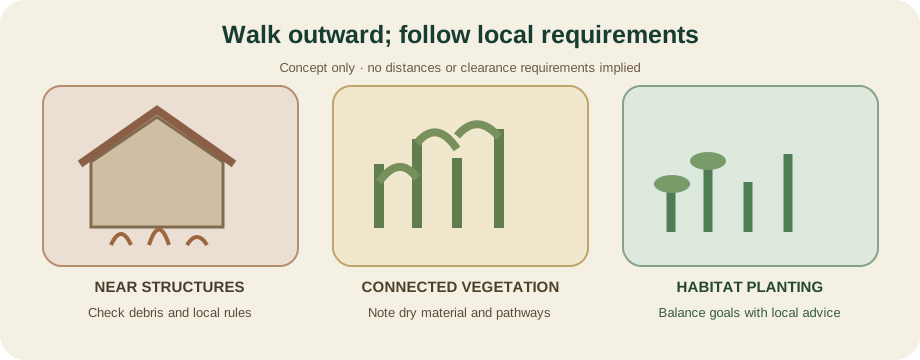
Start with local requirements
Check your fire department, municipality, provincial or state fire agency, and any insurance or property requirements before changing vegetation. Ask whether your address is in a designated risk zone and which current rules apply to structures, access, trees, grasses, and debris. FireSmart BC and Oregon State University Extension describe regional approaches; their distances, plant examples, and mowing guidance do not transfer automatically to another site.
Walk the property for condition and continuity
Look for dead branches, dry fine material, fallen leaves or needles caught near buildings, and plants that connect from the ground into tree crowns or structures. Note where shrubs, grasses, wood piles, fences, decks, and buildings sit relative to one another. Remove dead material where local guidance calls for it and dispose of it according to local fire and waste rules. Keep plants appropriately watered for their needs; drought-stressed or neglected vegetation can change the maintenance picture.
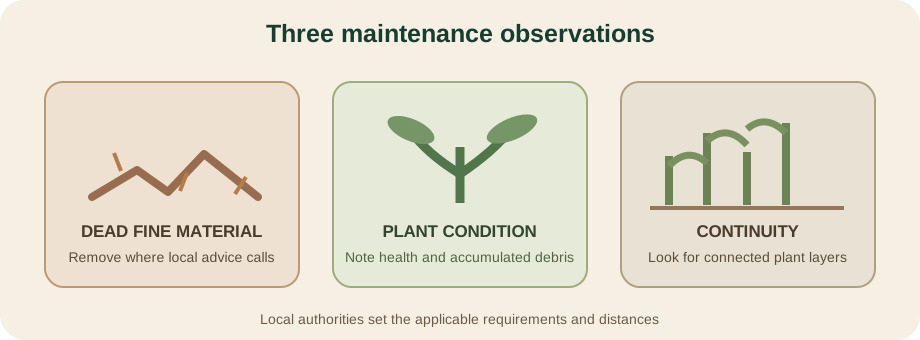
Where habitat goals overlap with a local fuel-management requirement, use the required zone and property conditions to guide the trade-off. Selective pruning, separating plant groups, or replacing a plant may be appropriate in some settings, but the right distance, season, and method depend on slope, wind, structure, and local rules. Do not clear an entire native bed based on a generic diagram or assume that a low-growing species is safe without local advice.
Keep maintenance ongoing
After wind, drought, or seasonal dieback, repeat the walk and remove newly accumulated material if guidance recommends it. Photograph changes and note which areas repeatedly collect dry debris. If the property needs a defensible-space assessment, ask the local fire authority or a qualified wildfire-risk professional. For habitat cleanup outside a fire-specific requirement, see seasonal cleanup for a pollinator garden.
Sources and further reading
- Landscaping Best Practicesauthoritative-secondary
- Fire-resistant Plants for Home Landscapesauthoritative-secondary