Checking stakes, ties, and shelters on young trees
Inspect temporary supports and protective hardware for rubbing, loosened stakes, broken ties, and growth that is outgrowing its shelter.
On this page
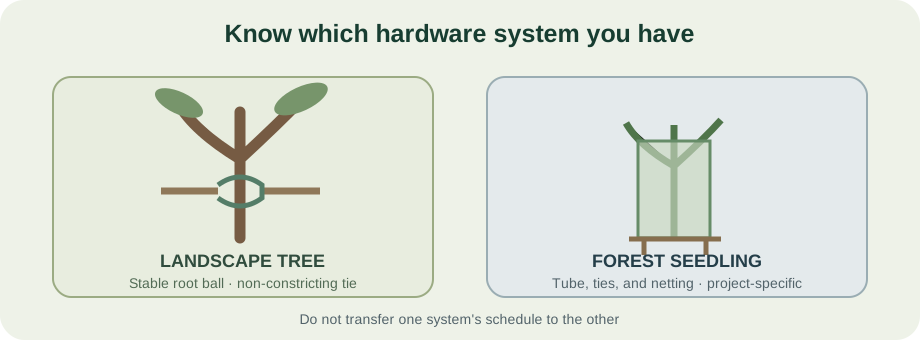
Stakes, ties, tubes, and netting can help in some planting systems, but they can also loosen, rub, or restrict growth as a tree changes. First identify what was installed and why. Keep the installer’s instructions or project plan; a landscape tree and a forest-restoration seedling do not share one support schedule.
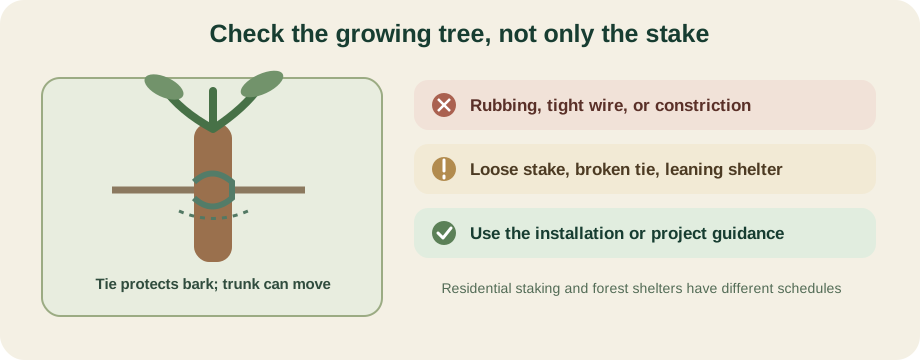
Check the tree and the hardware together
Look for a tie cutting into bark, wire or cord touching the trunk, a broken or leaning stake, a shelter rubbing foliage, or netting that can catch new growth. After a strong wind or storm, check whether a shelter leans, its stake is firm, and its ties remain intact. Note trunk movement and whether the tree appears stable; do not tighten a tie simply to eliminate all movement.
Maryland Extension says a correctly planted landscape tree with an adequately sized root ball often does not need staking, though a slope or windy site may change that decision. Its guidance calls for removing support after the first year. Treat that as a Maryland example and review the tree’s condition and installation instructions before acting elsewhere.
Treat tree shelters as a different system
Tube shelters and netting are common in forest or restoration plantings, where wildlife protection and project goals shape maintenance. Penn State Extension describes repeated shelter checks in that context, including after storms, and removal of netting before shoots become entangled. It does not establish a residential inspection calendar. Follow the land manager’s or manufacturer’s guidance for your system and check that a shelter is not leaning onto the seedling or restricting growth.
If wire has begun to embed in a landscape tree, do not yank a section that has become fully enclosed by the trunk. Maryland Extension advises removing partly embedded wire promptly; a fully encased section may be safer to leave while removing exposed excess and monitoring the tree. Because a damaged trunk can become a safety concern, ask an arborist before cutting into it. See winter care for newly planted woody plants for a separate seasonal root-zone check.
Sources and further reading
- Embedded Wires, Nylon Cord, and Wire Basketsauthoritative-secondary
- Forest Landowners Guide to Tree Planting Successauthoritative-secondary
- After the Storm: Tree Shelter Maintenanceauthoritative-secondary