Buying source-identified native seed in Ontario
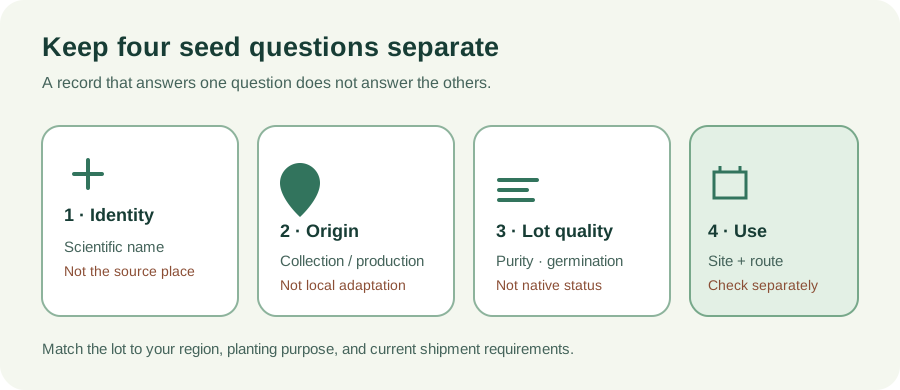
Separate a seed label's identity and origin claims from native range, lot quality, local adaptation, and shipment eligibility.
On this page
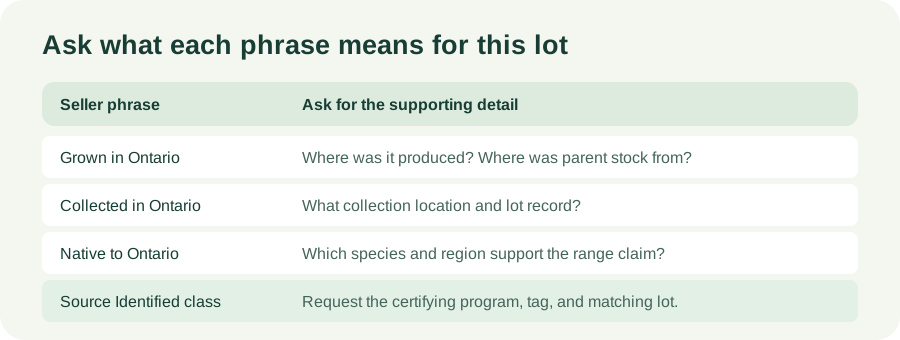
“Source-identified” can describe a documented origin, a formal certification class, or a seller’s wording. Ask what the phrase means for the exact lot. A source location can help you evaluate a purchase, but it does not by itself prove that the species is native to your part of Ontario, adapted to your garden, or permitted to cross a border.
Ask what the origin statement records
Start with the scientific name and the region where you plan to sow the seed. Then ask for the lot number, the collection or production location, the year, and whether the seed was collected from wild plants or produced from parent stock. “Grown in Ontario,” “collected in Ontario,” and “native to Ontario” are not interchangeable. Ask which statement applies to the lot and what record supports it.
In the United States, AOSCA’s Pre-Variety Germplasm program has a specific Source Identified class. A seller’s use of similar words does not show that the lot carries that certification. If a certification is claimed, request the tag, certifying agency, and matching lot information. Certification terms describe only the program’s stated checks; they do not establish local fit for your garden.
Ontario’s Tree Seed Transfer Policy tracks collection and deployment geography for tree seed and planting stock used in Crown-forest renewal and certain supported forestry work. It is a useful example of why source records matter, but it is not a universal retail rule for every garden seed packet or herbaceous species.
Check quality and the order separately
Ask for the latest available purity and germination results, test date, and how the seller calculates the amount in a bulk order. A lot test helps compare seed quality; it does not prove origin or garden performance. For a mix, request the scientific name and share of every component rather than relying on a broad “native mix” label.
If seed will cross a border, use the current CFIA seed-import guidance with the exact seed, origin, destination, and purpose. Import permission is a separate check from native status or certification. Reconfirm the lot, quantity, and shipment terms before paying.
Sources and further reading
- Ontario Tree Seed Transfer Policyprimary
- Pre-Variety Germplasmspecialist
- ABCs of seed importation into Canadaprimary